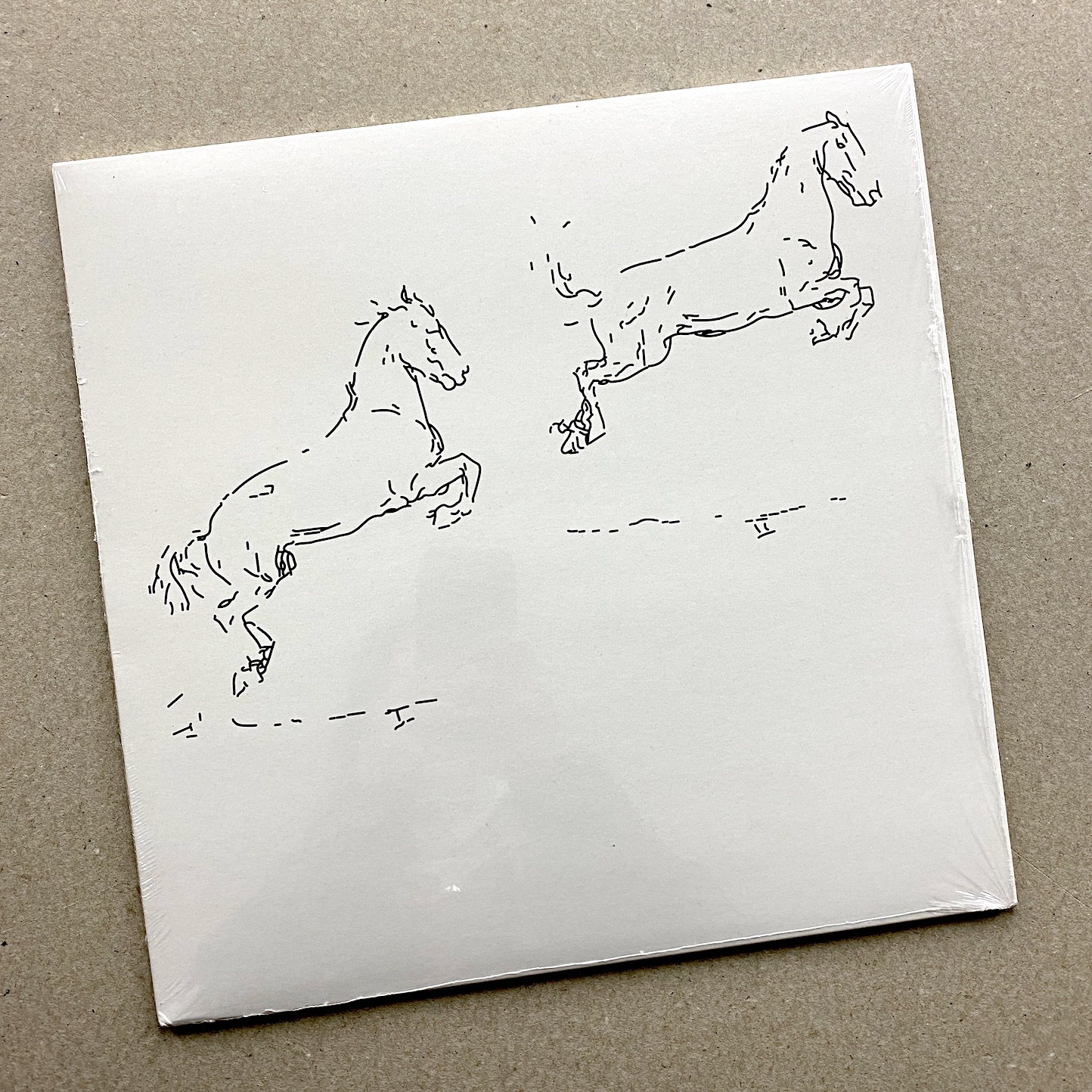
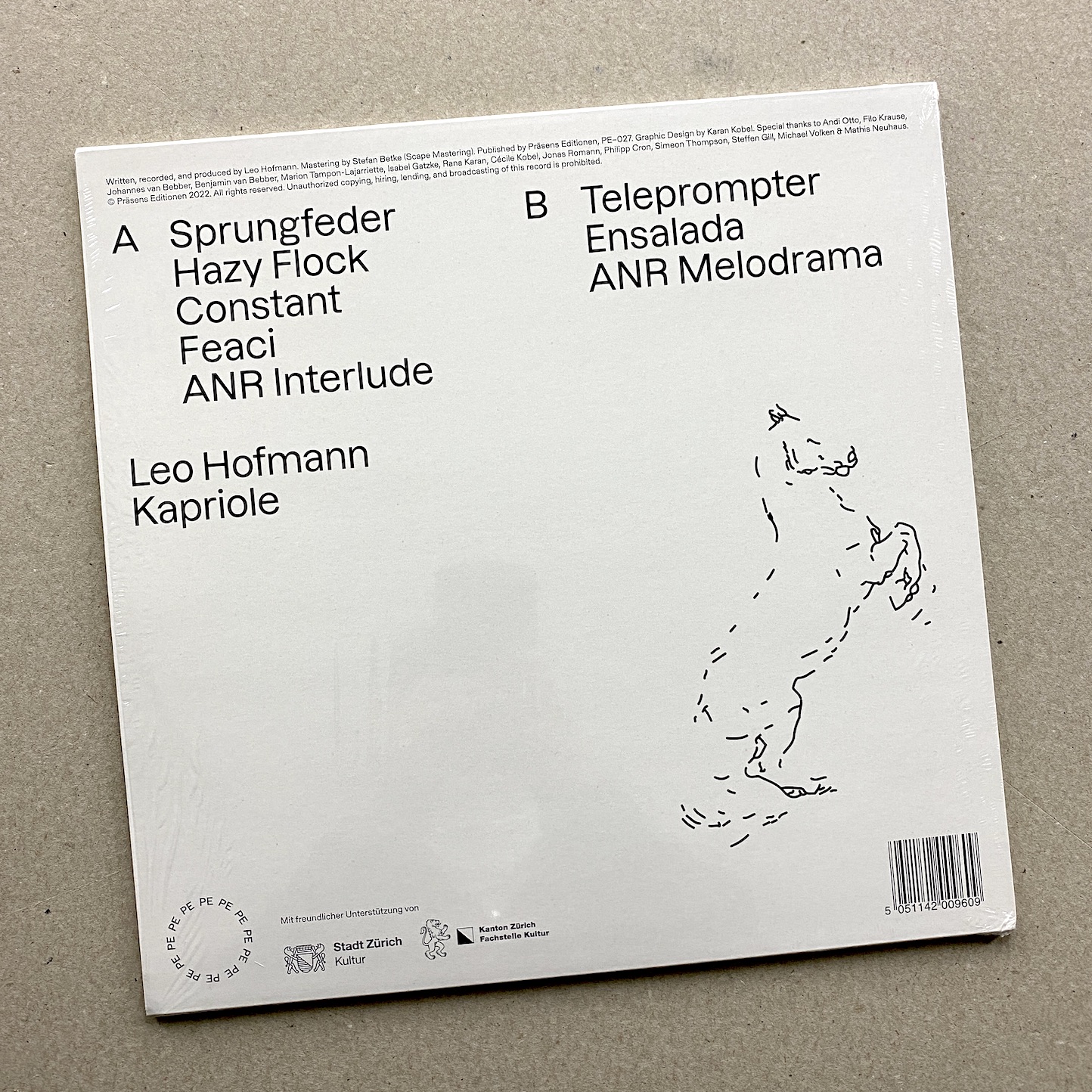
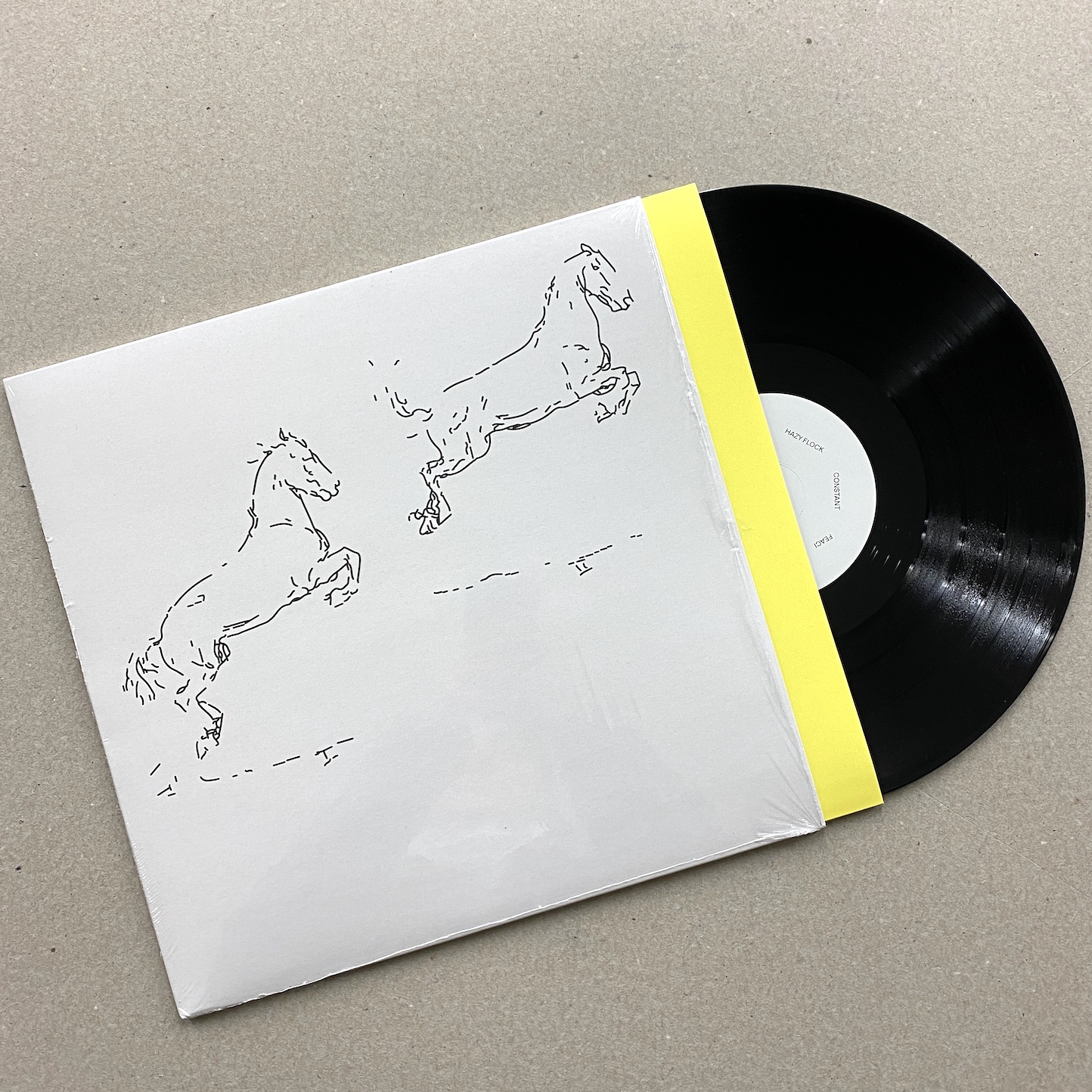
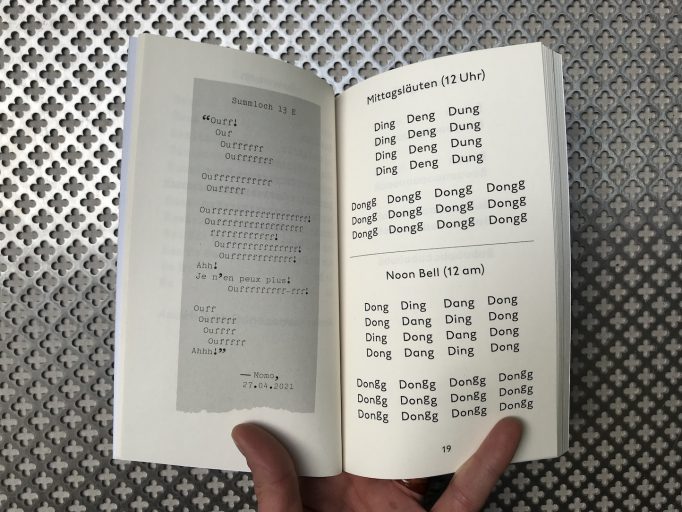
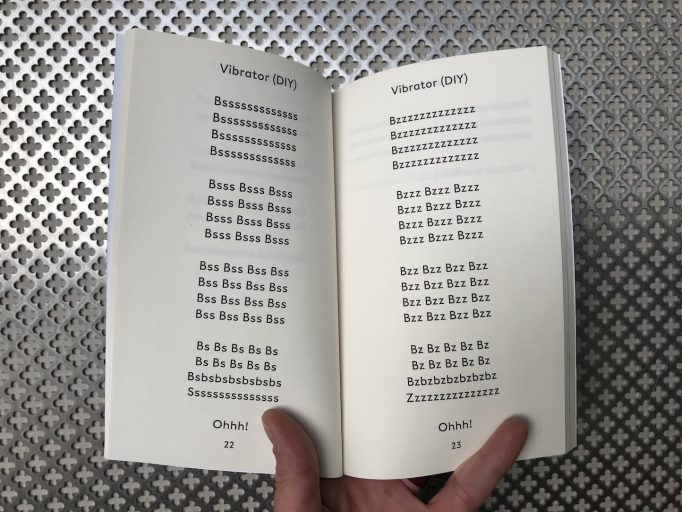
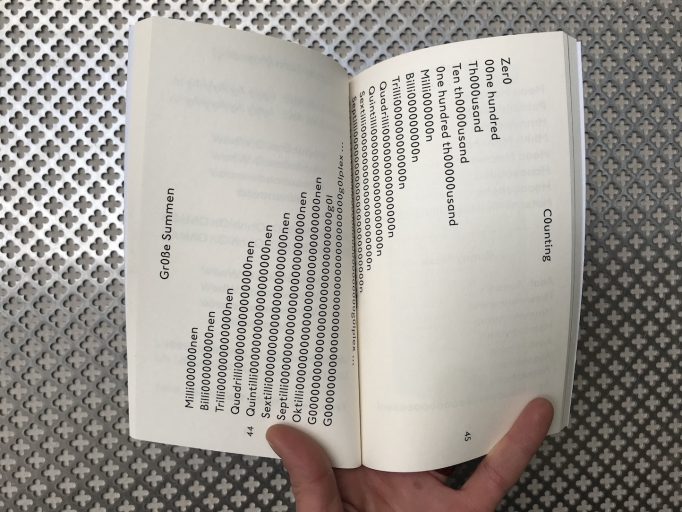
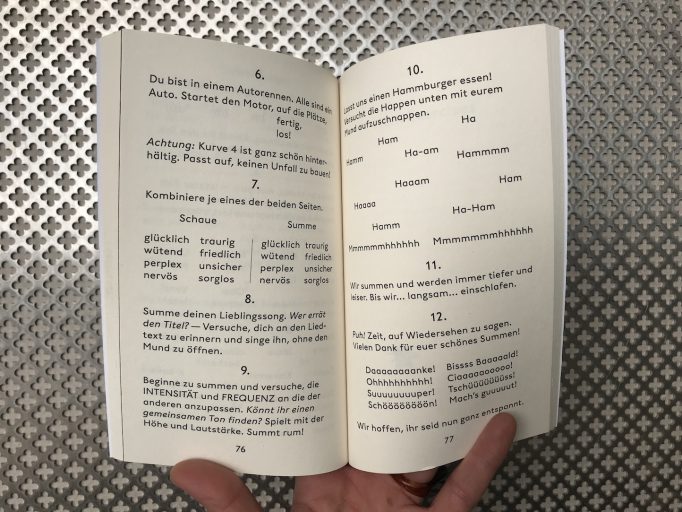
Kapriole is the debut album by Zurich- and Hamburg-based artist Leo Hofmann– after working in music theatre, sound art, and performance contexts. Central to the album, which refers in its title to a joyous jump, is the ambition to translate an ephemeral practice into recorded matter. Fixed but never static, Kapriole is informed by intimate and detailed listening situations and sound practices like ASMR or the acoustically sheltered world of noise cancelling headphones. And while it is apparent that Hofmann has a deeply rooted understanding of technology and its abundant possibilities, Kapriole is a tender and almost analogue feeling affair. The human voice occupies a central role in the musical configuration of the album: quirky repetitions, hushed fragments and poetic statements, circling topics like communication, mobility, and immersion occupy the album’s eight tracks. The result is a sonorous sensation, which, in its scarcity, paves the way for meticulously crafted and delicate soundscapes.
Written, recorded, and produced by Leo Hofmann.
Mastering: Stefan Betke (Scape Mastering Berlin) Graphic Design: Karan Kobel
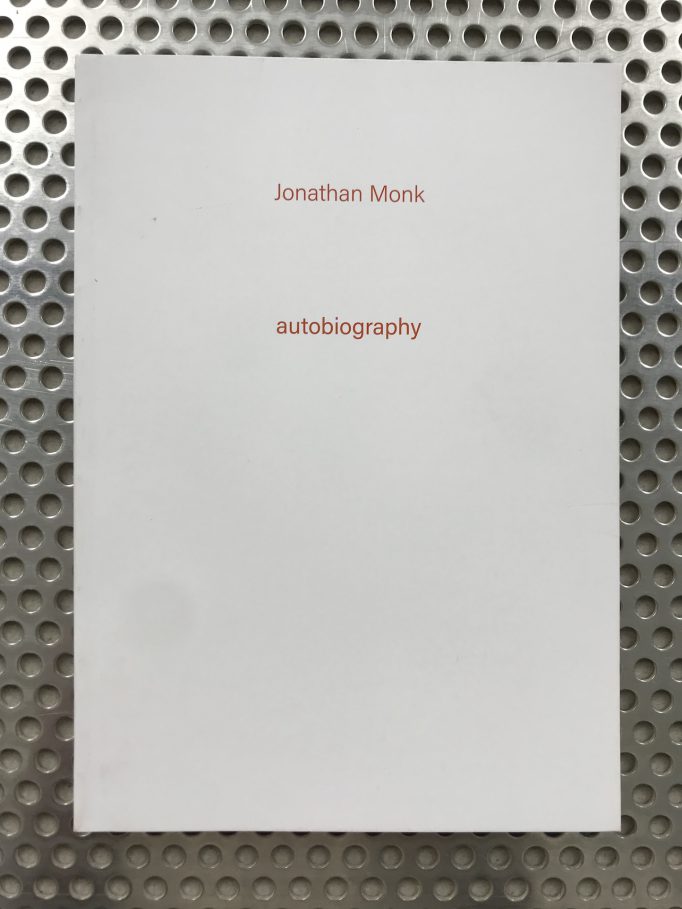
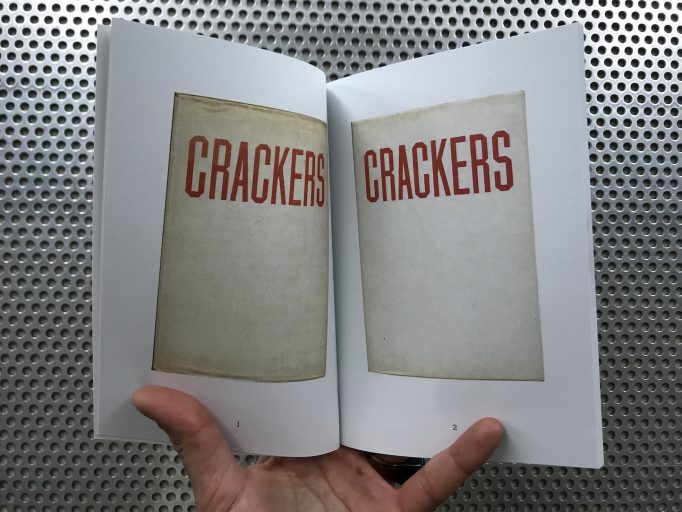
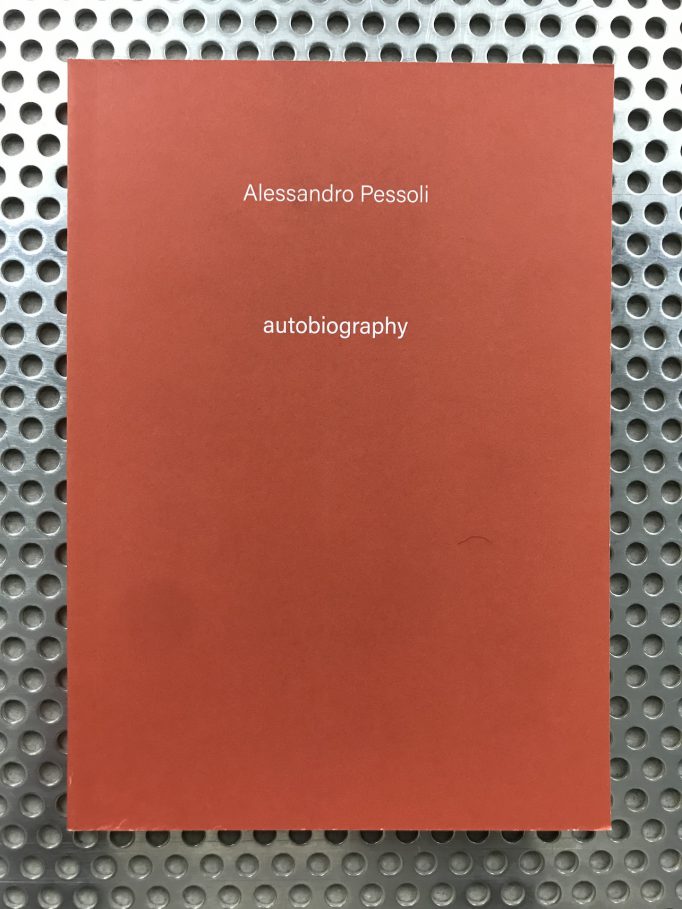
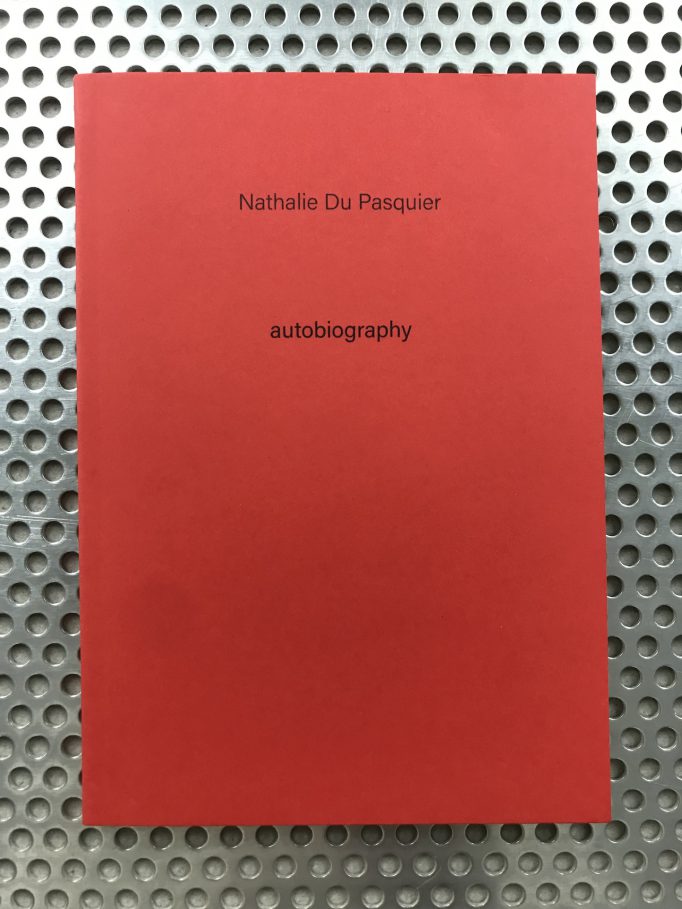
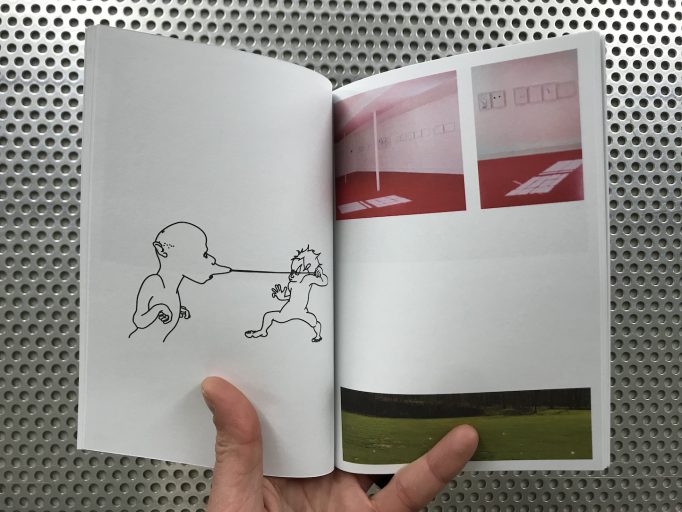
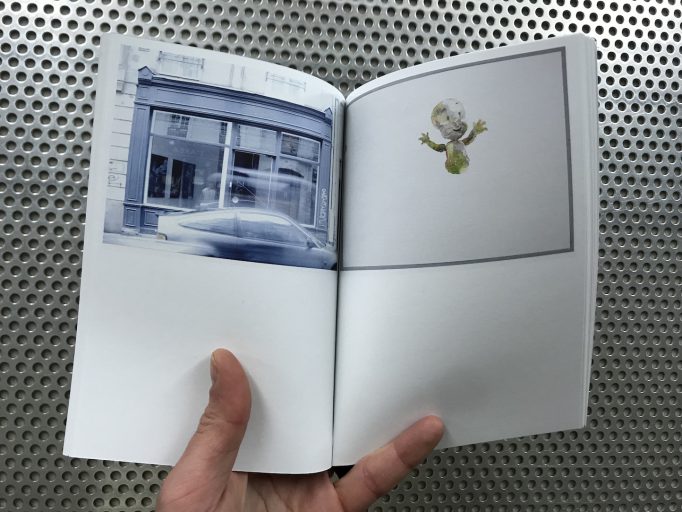
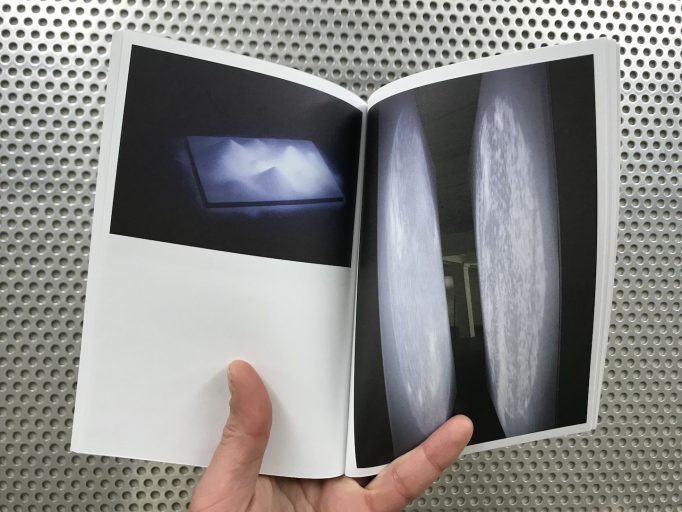
Autobiography is a series by Tonini Editore, published monthly. Each volume will be dedicated to an artist, who will be free to carry out the topic of the autobiography by means of text or visual supports.
The selection of the artists participating to the series is coordinated by a scientific committee made up of six renown personalities in the world of the art research and collection: Pedro Barbosa (collector and founder of the Coleção Moraes – Barbosa), Alex Bacon (art historian), Claudio Guenzani (gallery owner in Milan, owner of the Studio Guenzani), Michele Lombardelli (artist, composer, typographer and consultant for several publishing houses), Shwetal Ashvin Patel (writer and researcher, founding member of the Kochi-Muziris Biennale), Christoph Schifferli (collector and scholar), Valentino Tonini (director of the homonymous publishing house).
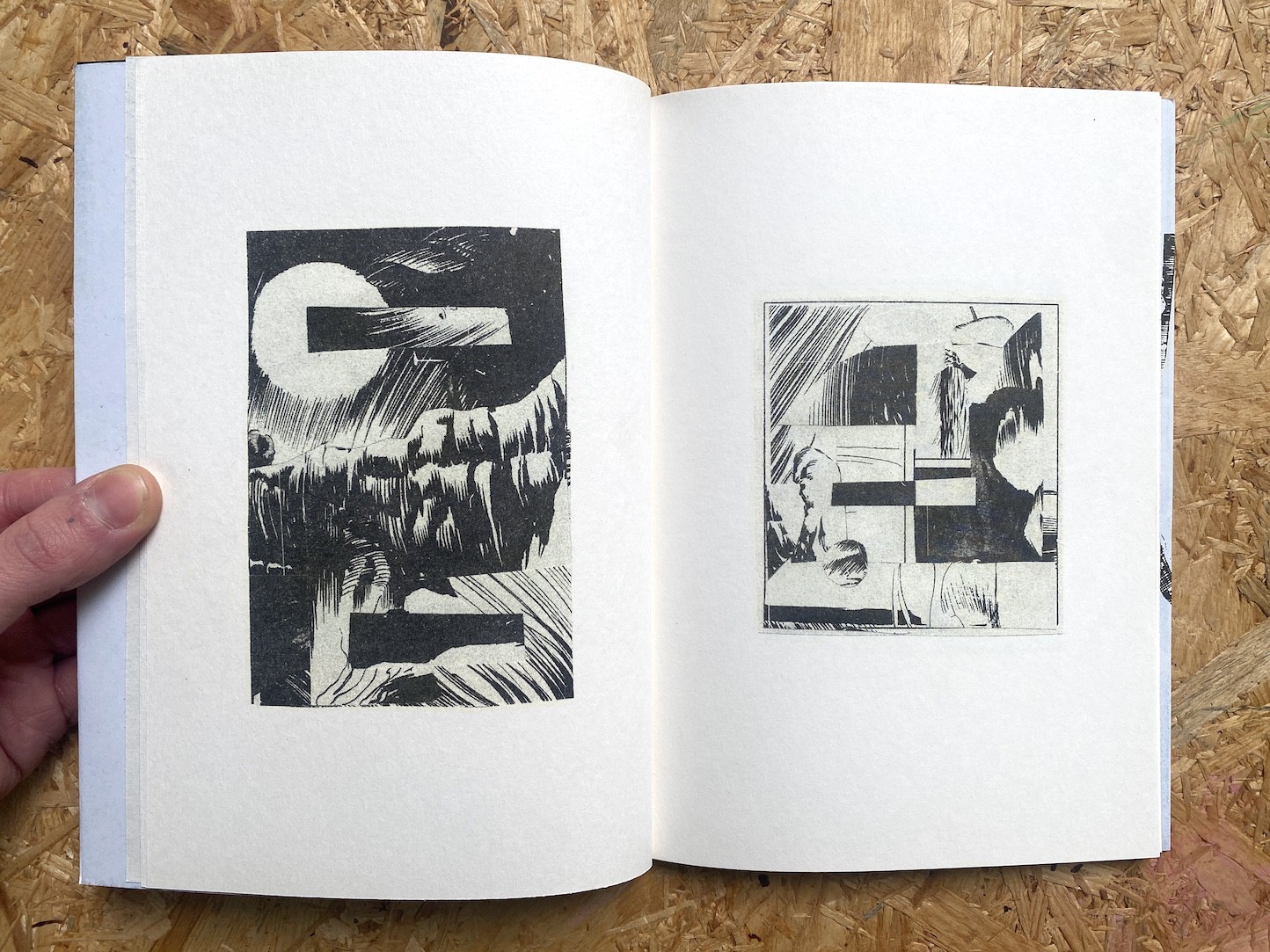
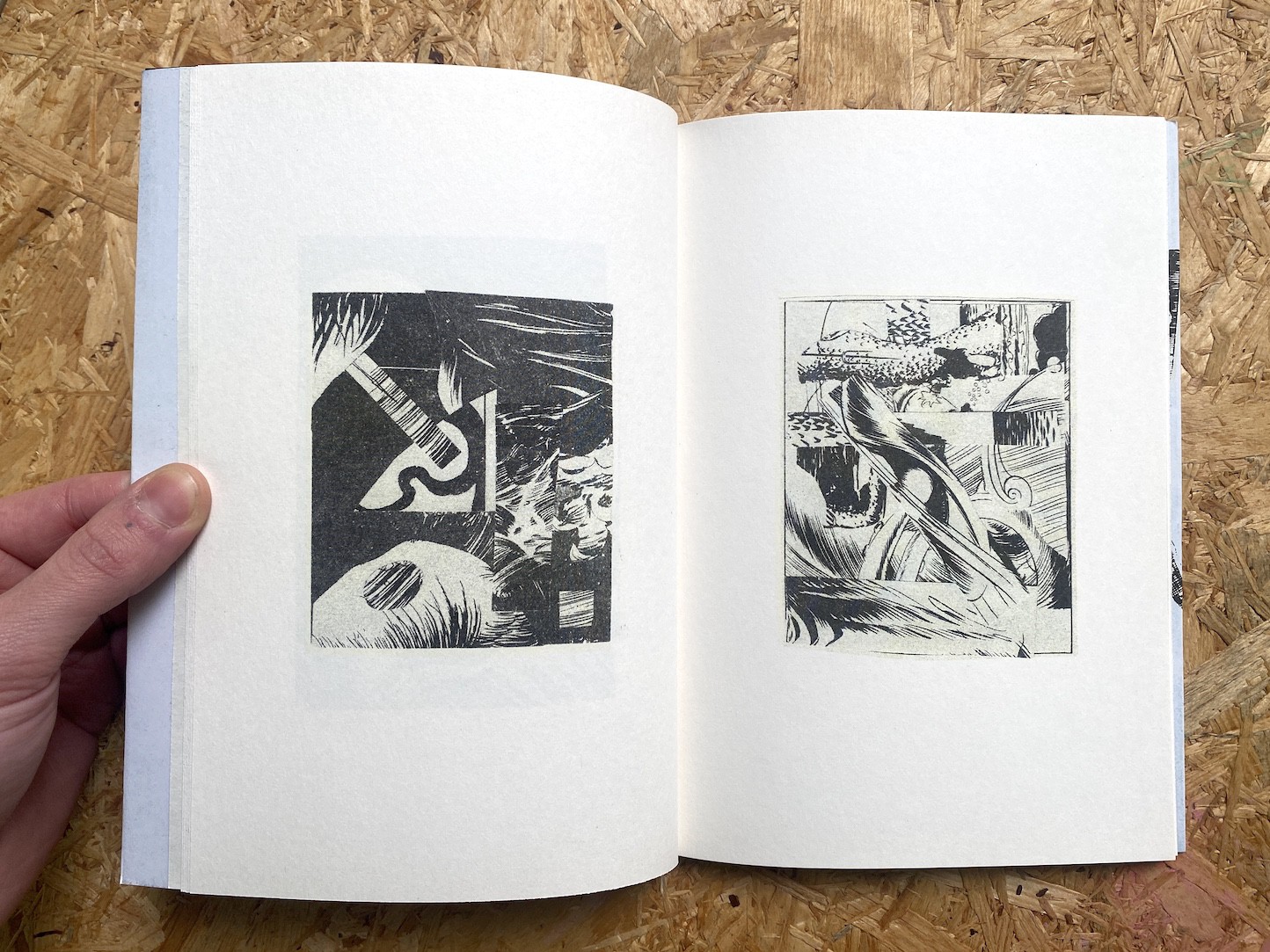
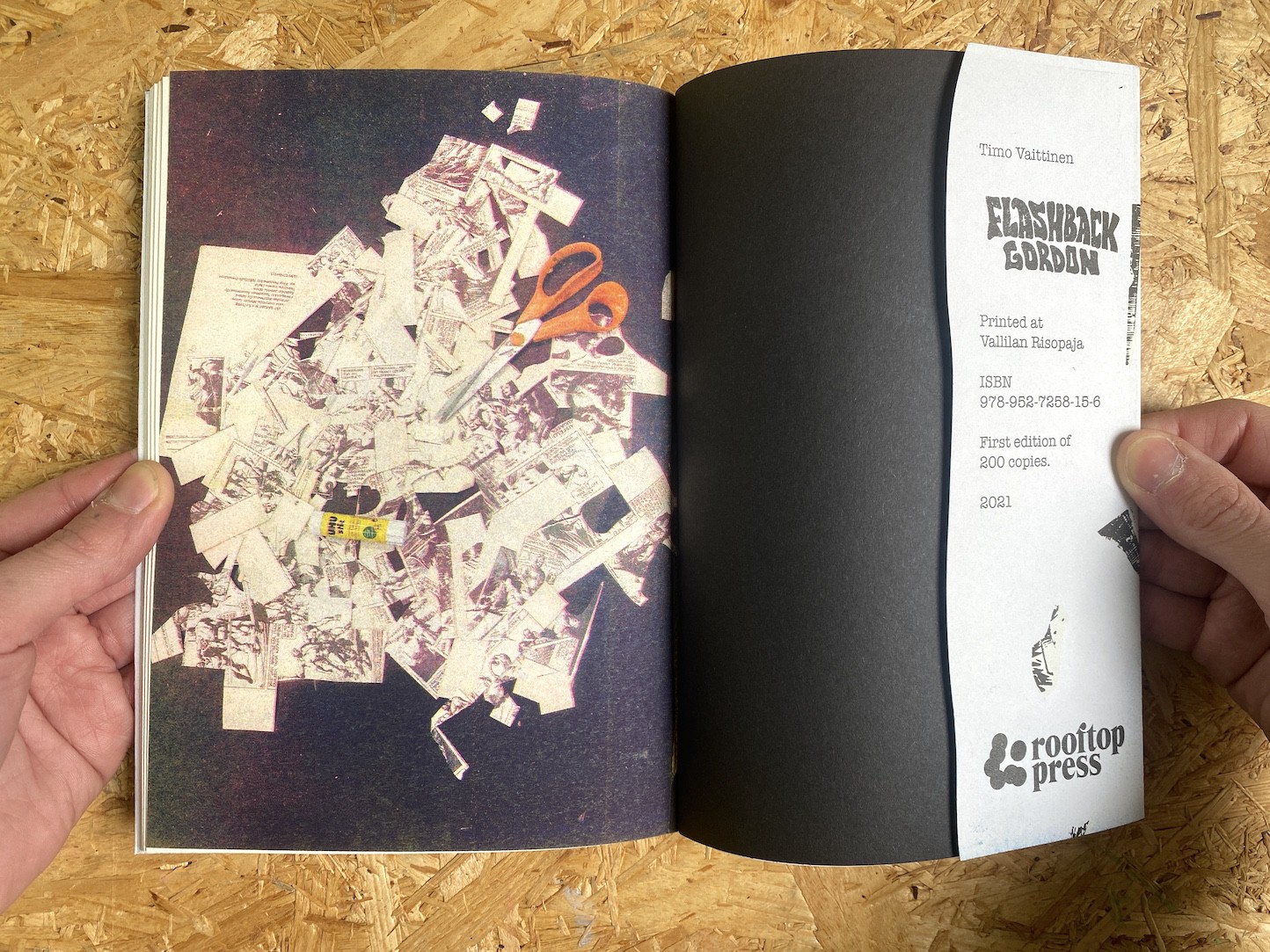
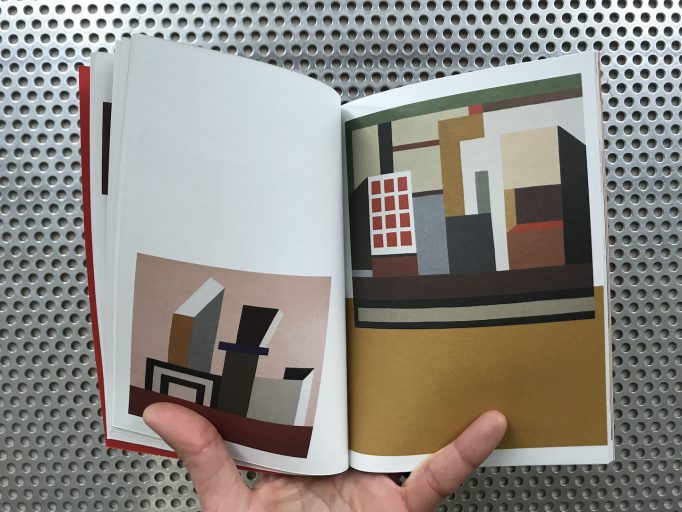
A comic album once discarded from a public library and later found on the street by the artist on his way to his studio is transformed into a series of abstract collages. Using simple cut and paste tactics a collection of science fiction narratives is reorganised into images drifting away from definition to be reproduced as Risograph prints on the pages of Flashback Gordon.
Autobiography is a series by Tonini Editore, published monthly. Each volume will be dedicated to an artist, who will be free to carry out the topic of the autobiography by means of text or visual supports.
The selection of the artists participating to the series is coordinated by a scientific committee made up of six renown personalities in the world of the art research and collection: Pedro Barbosa (collector and founder of the Coleção Moraes – Barbosa), Alex Bacon (art historian), Claudio Guenzani (gallery owner in Milan, owner of the Studio Guenzani), Michele Lombardelli (artist, composer, typographer and consultant for several publishing houses), Shwetal Ashvin Patel (writer and researcher, founding member of the Kochi-Muziris Biennale), Christoph Schifferli (collector and scholar), Valentino Tonini (director of the homonymous publishing house).
Autobiography is a series by Tonini Editore, published monthly. Each volume will be dedicated to an artist, who will be free to carry out the topic of the autobiography by means of text or visual supports.
The selection of the artists participating to the series is coordinated by a scientific committee made up of six renown personalities in the world of the art research and collection: Pedro Barbosa (collector and founder of the Coleção Moraes – Barbosa), Alex Bacon (art historian), Claudio Guenzani (gallery owner in Milan, owner of the Studio Guenzani), Michele Lombardelli (artist, composer, typographer and consultant for several publishing houses), Shwetal Ashvin Patel (writer and researcher, founding member of the Kochi-Muziris Biennale), Christoph Schifferli (collector and scholar), Valentino Tonini (director of the homonymous publishing house).
Autobiography is a series by Tonini Editore, published monthly. Each volume will be dedicated to an artist, who will be free to carry out the topic of the autobiography by means of text or visual supports.
The selection of the artists participating to the series is coordinated by a scientific committee made up of six renown personalities in the world of the art research and collection: Pedro Barbosa (collector and founder of the Coleção Moraes – Barbosa), Alex Bacon (art historian), Claudio Guenzani (gallery owner in Milan, owner of the Studio Guenzani), Michele Lombardelli (artist, composer, typographer and consultant for several publishing houses), Shwetal Ashvin Patel (writer and researcher, founding member of the Kochi-Muziris Biennale), Christoph Schifferli (collector and scholar), Valentino Tonini (director of the homonymous publishing house).
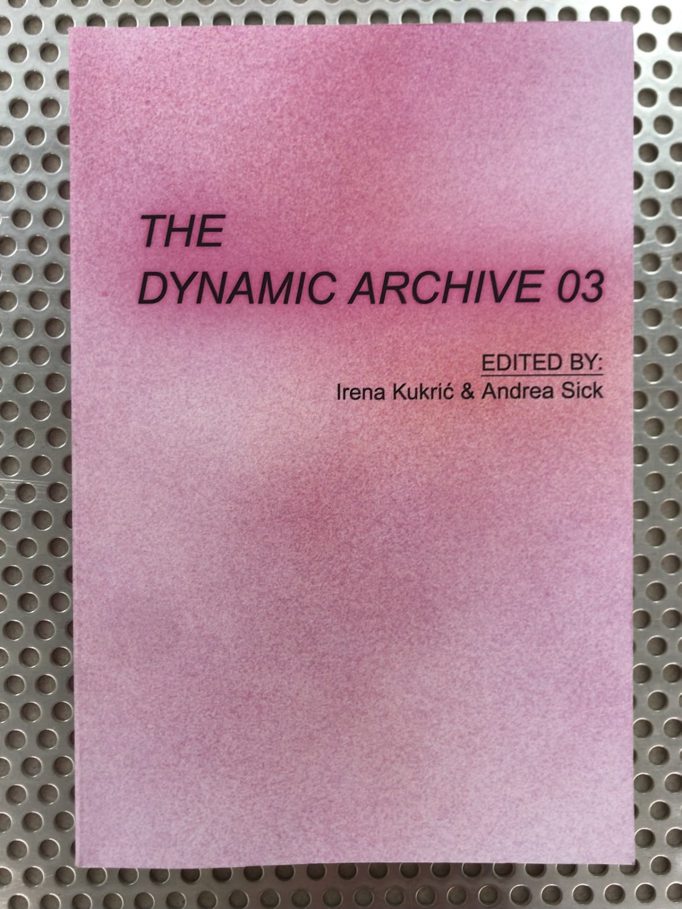
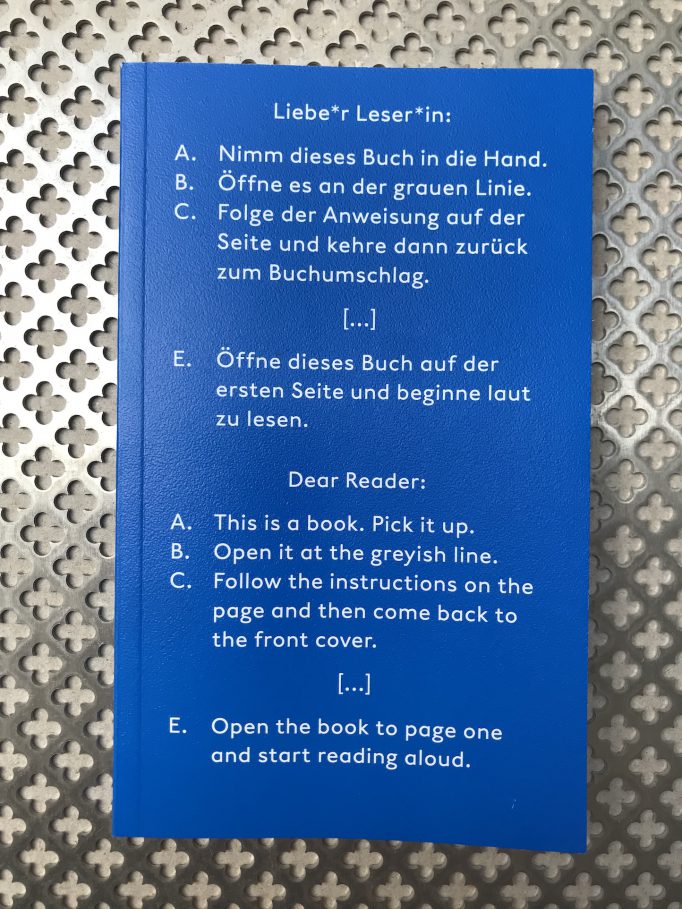
The Dynamic Archive 01 (thedynamicarchive.net) has been an online platform since 2018. The Version Room as physical gallery space is known as The Dynamic Archive 02.
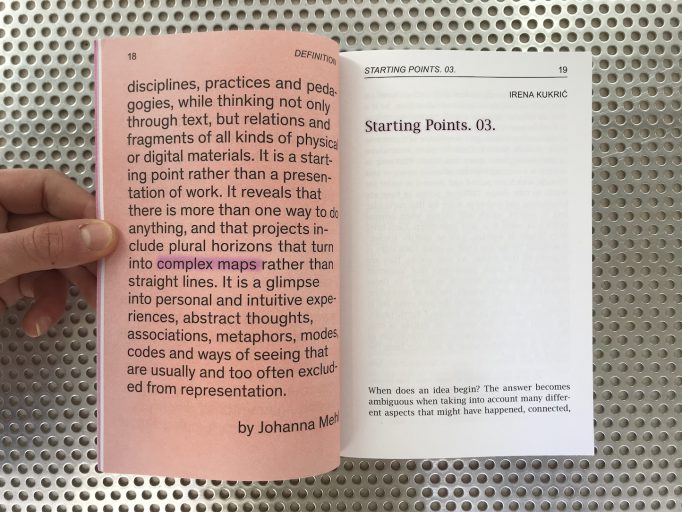
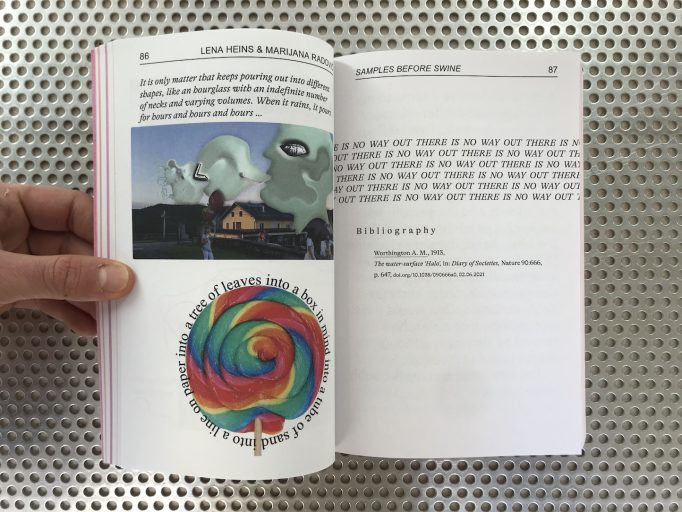
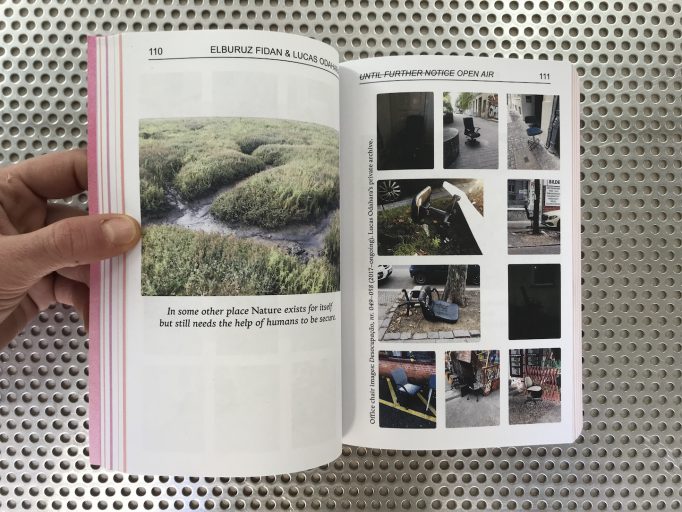
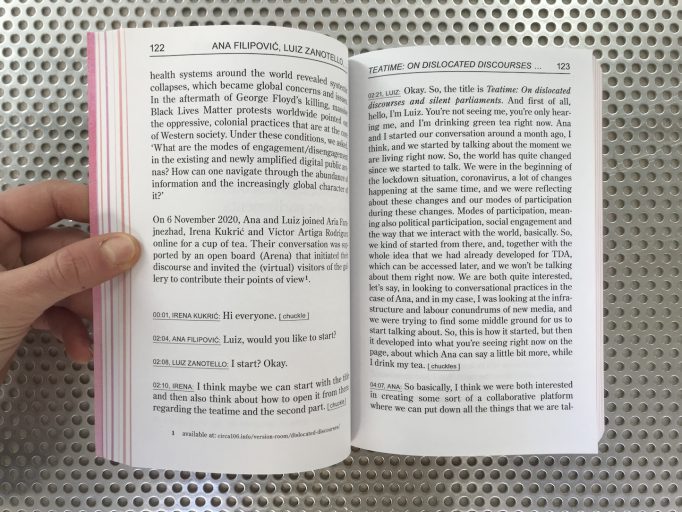
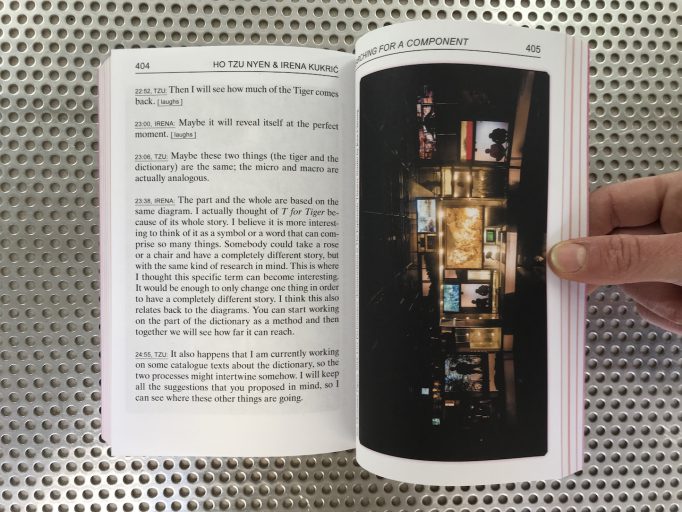
It compiles various margin notes and contexts related to the components of the online platform and the themes of collaborative work in the context of art, which were presented, performed or heard at certain points within the context of the artistic-scientific research project The Dynamic Archive, and are now the starting points for contributions to this book. The archive’s various framings are interrupted by numerous, very different Definitions of The Dynamic Archive written by invited artists, designers, and scientists who have had experiences with The Dynamic Archive, all of which demonstrate that The Dynamic Archive is a great many things simultaneously. Contributions range from artists who worked with us in our Artist in Residency programs, such as Ho Tzu Nyen and Antonia Baehr, to artists and designers who were invited to give a lecture like Susanne Kennedy, MPA, Emma Hedditch or Sven Jonke from Numen / For Use as well as many others who contributed with their components or within the program Version Room with The Dynamic Archive. This publication is as well an overview of how it has developed until now and a starting point for further thought on what The Dynamic Archive can be.
Contributions by: Florian Ackermann, Victor Artiga Rodriguez, Antonia Baehr, Ralf Baecker, Franziska Bauer, Heike Kati Barath, Harm Coordes, Jorn Ebner, Aria Farajnezhad, Ana Filipović, Elburuz Fidan, Anja Groten, Emma Hedditch, Lena Heins, Julian-Anthony Hespenheide, Iris Maria vom Hof, Pirkko Husemann, Moritz Ingwersen, Charlotte Jarvis, Susanne Kennedy, Irena Kukrić, Ingmar Lähnemann, Leon Lothschütz, Sebastian Lütgert, Mona Mahall, Katrin von Maltzahn, Johanna Mehl, Ixchel Mendoza Hernández, Eva Meyer-Keller, MPA, Numen / For Use, Henrik Nieratschker, Ho Tzu Nyen, Lucas Odahara, Dennis P. Paul, Luiza Prado, Marijana Radović, Iulia Radu, Guida Ribeiro, Emilia Schlosser, Asli Serbest, Pablo Somonte Ruano, Raphael Sbrzesny, Mona Schieren, Carmem Saito, Andrea Sick, Luiz Zanotello.