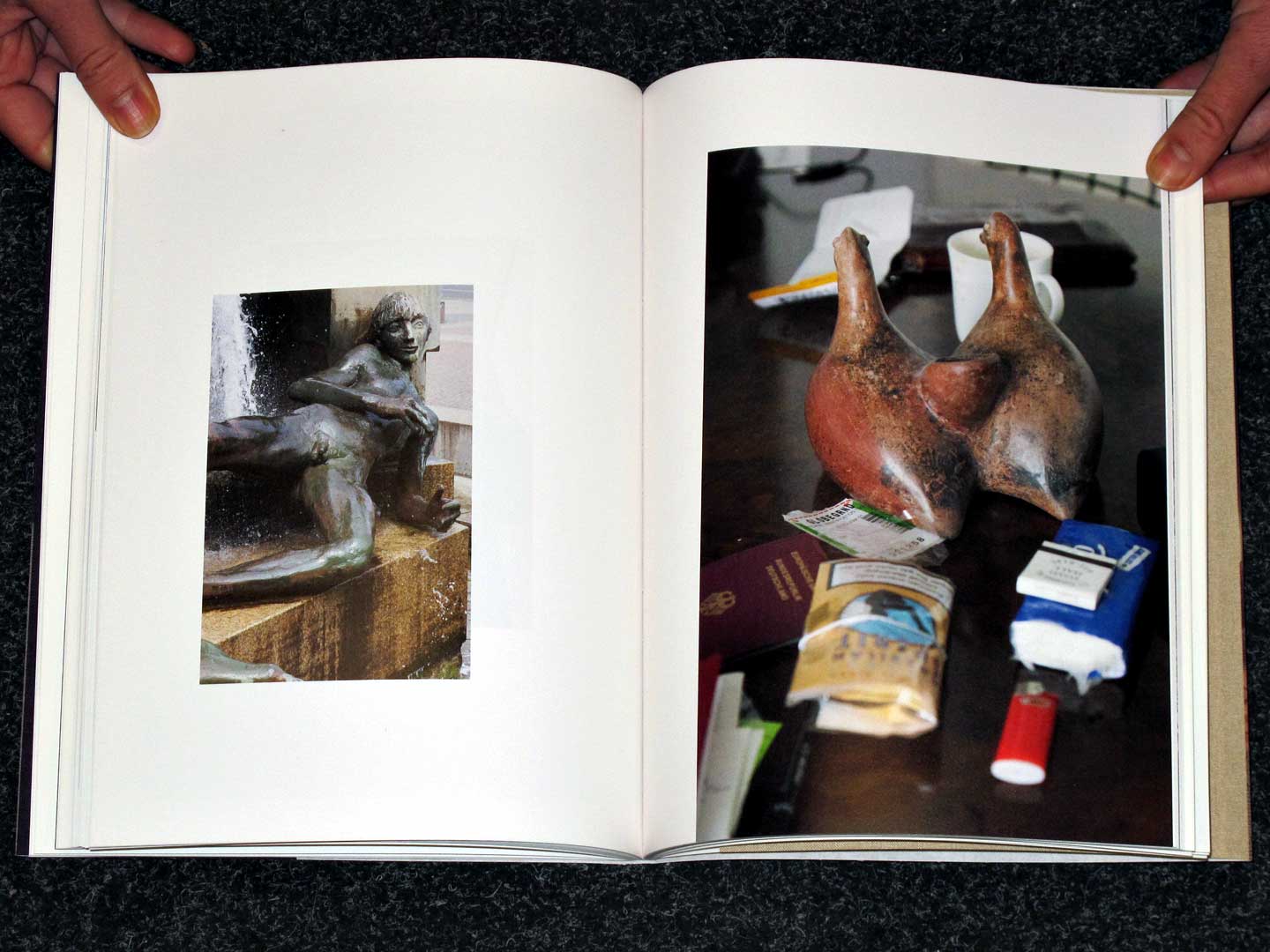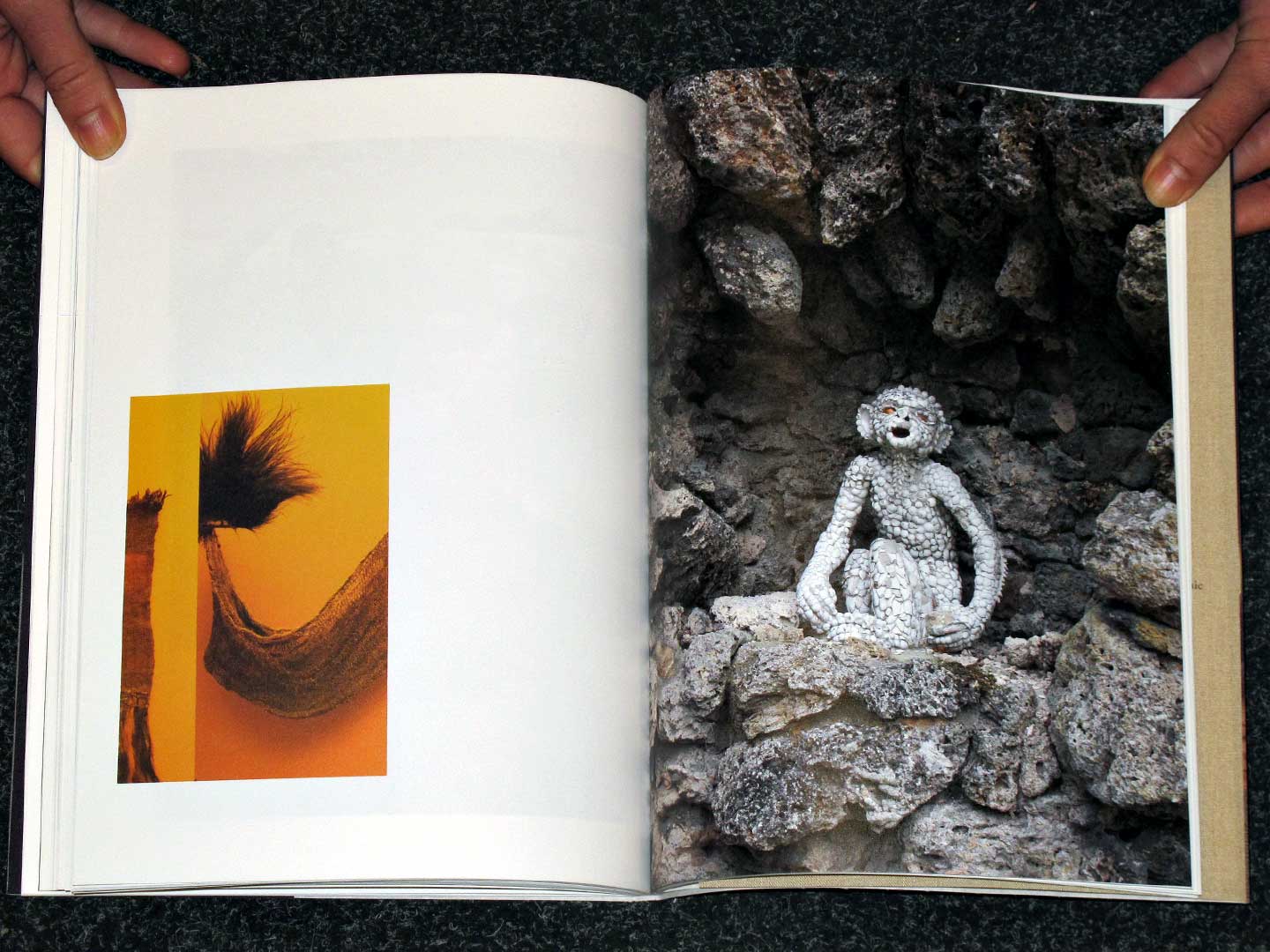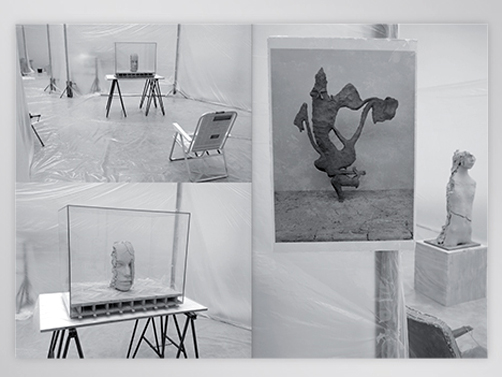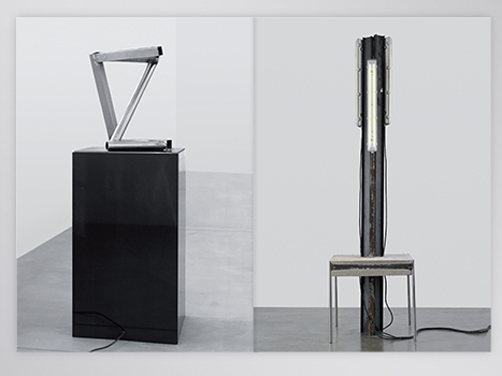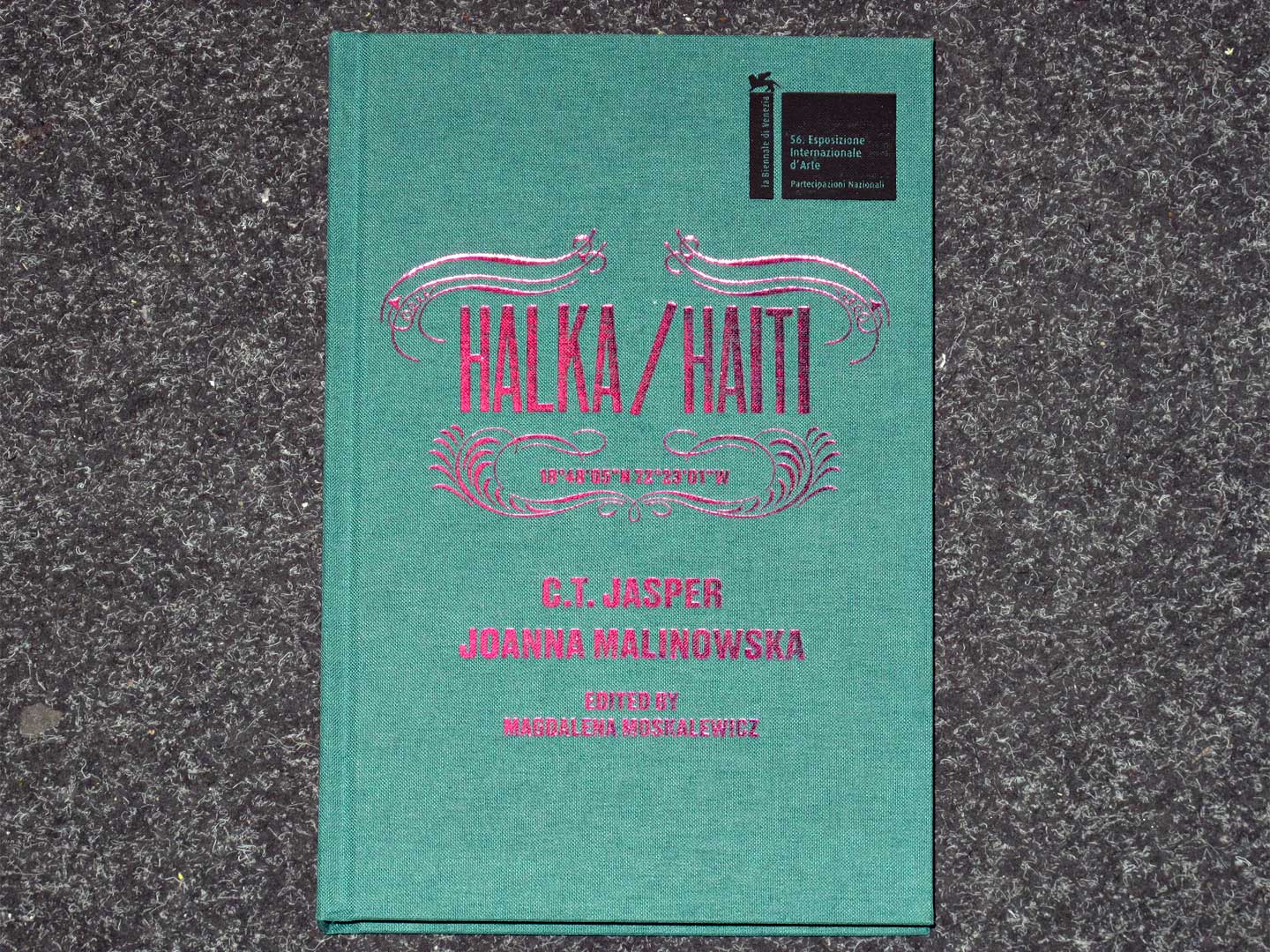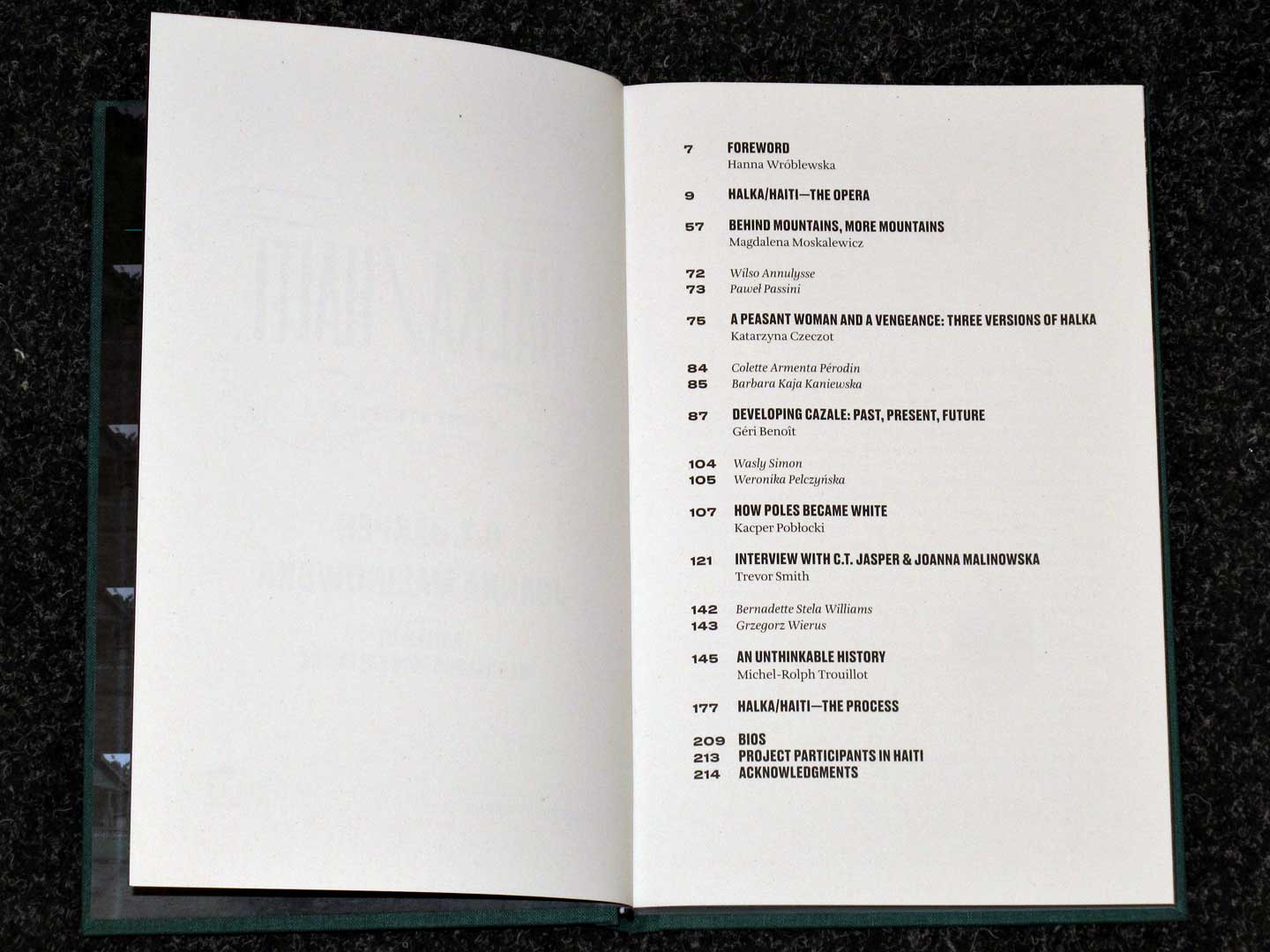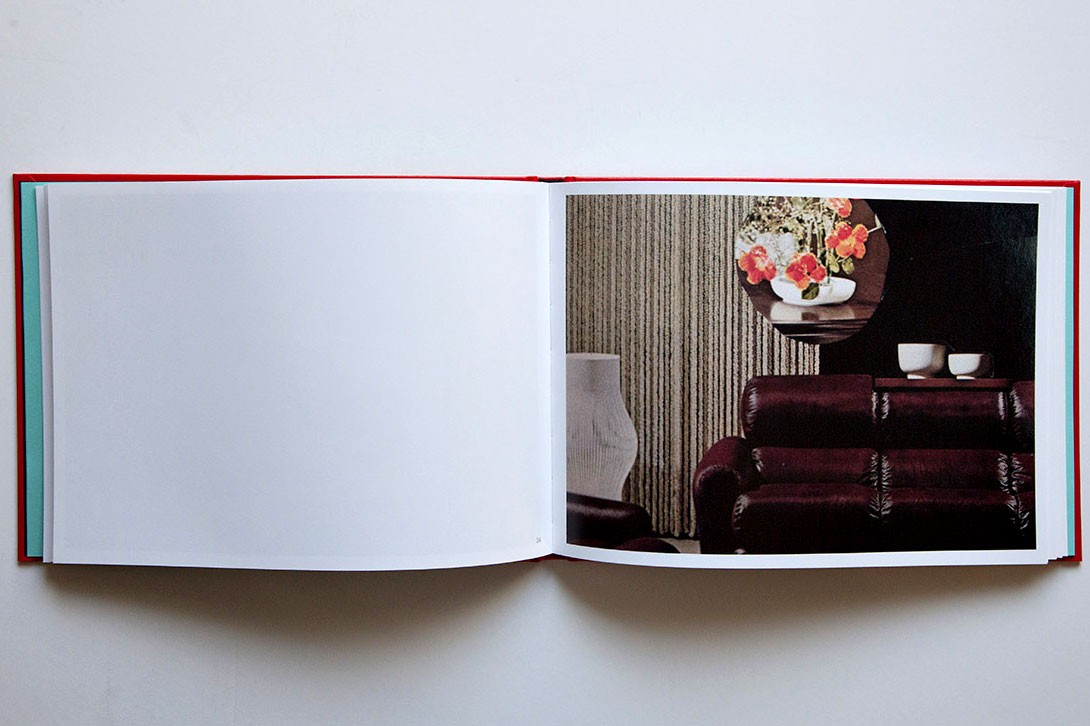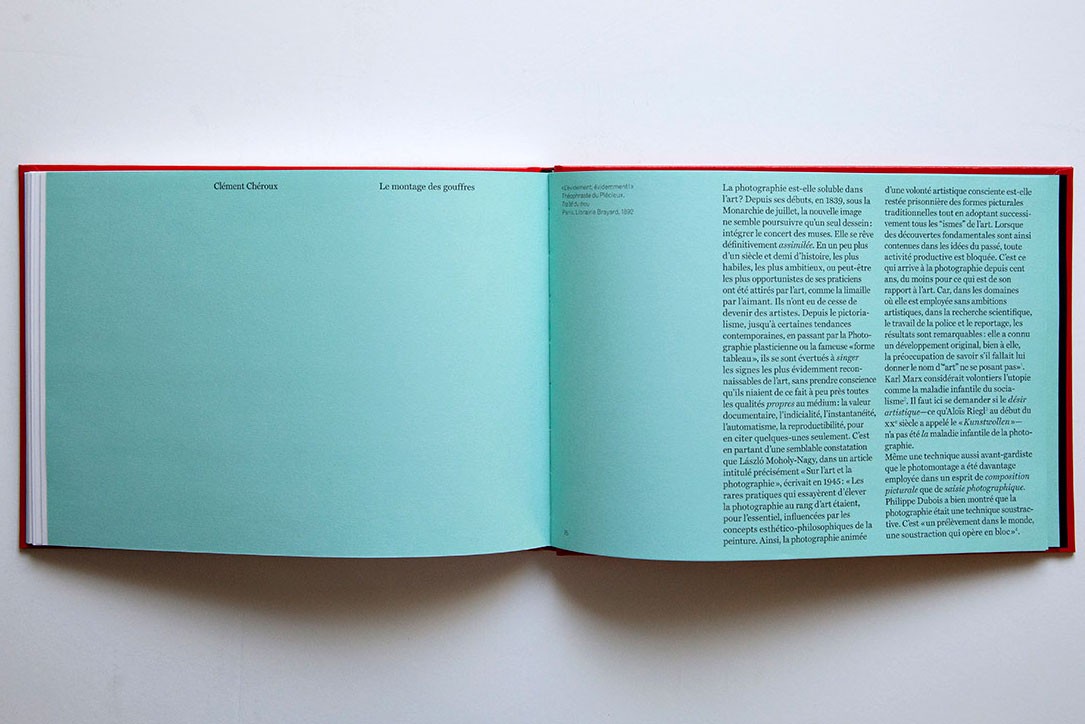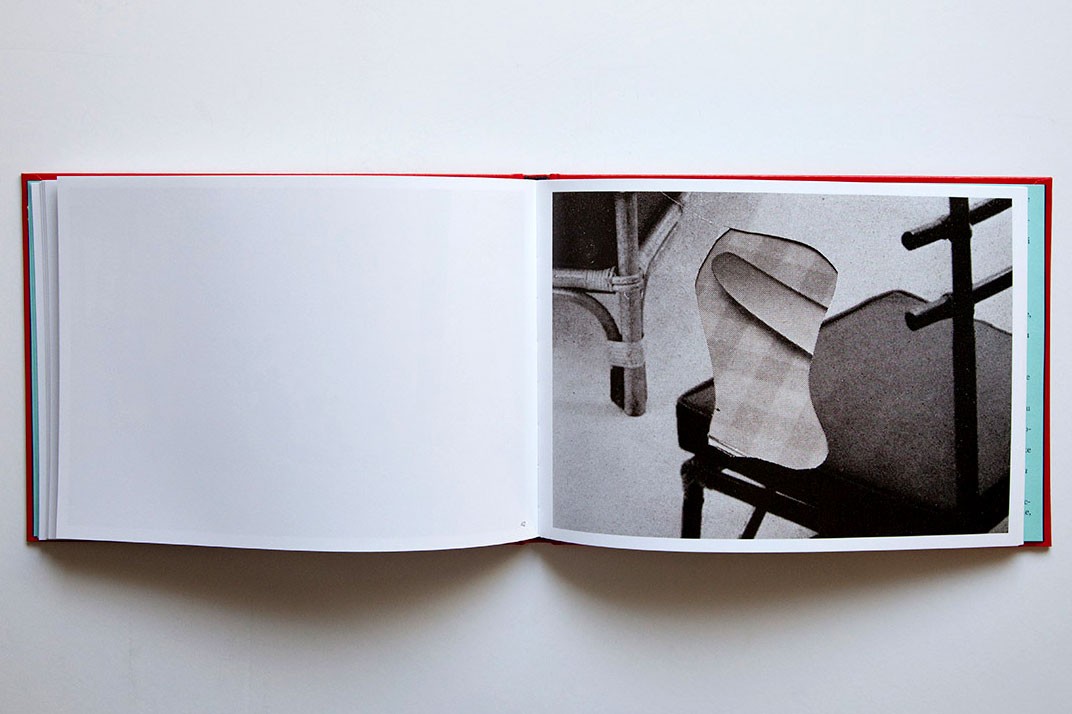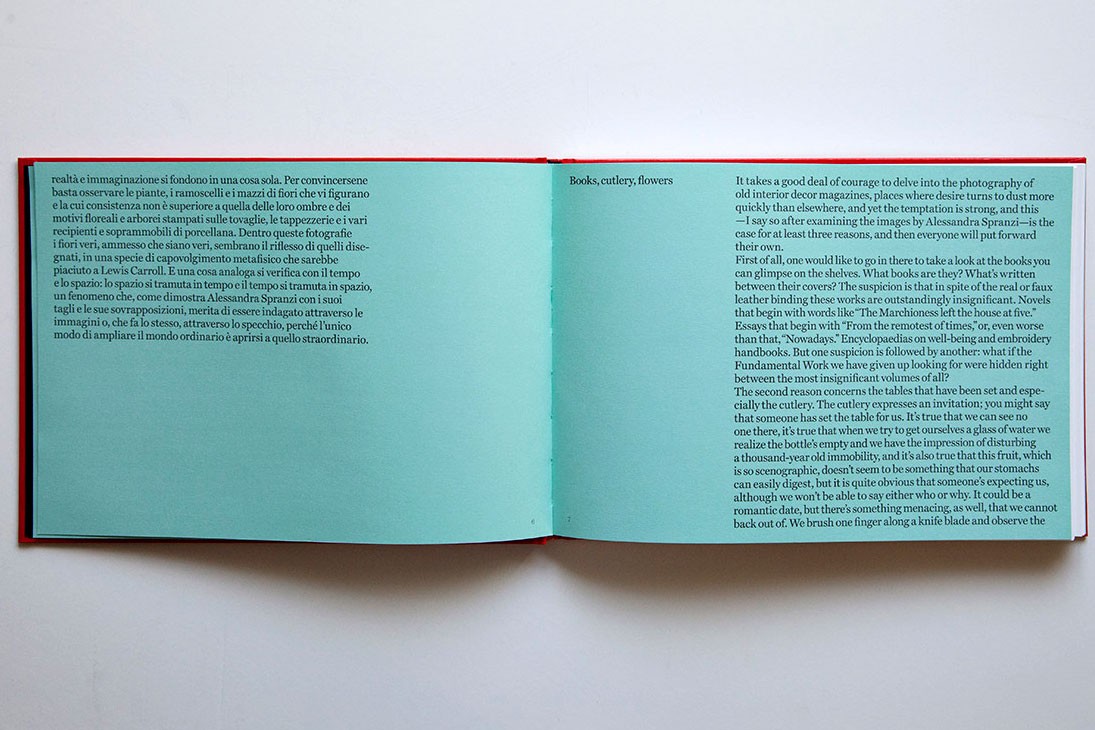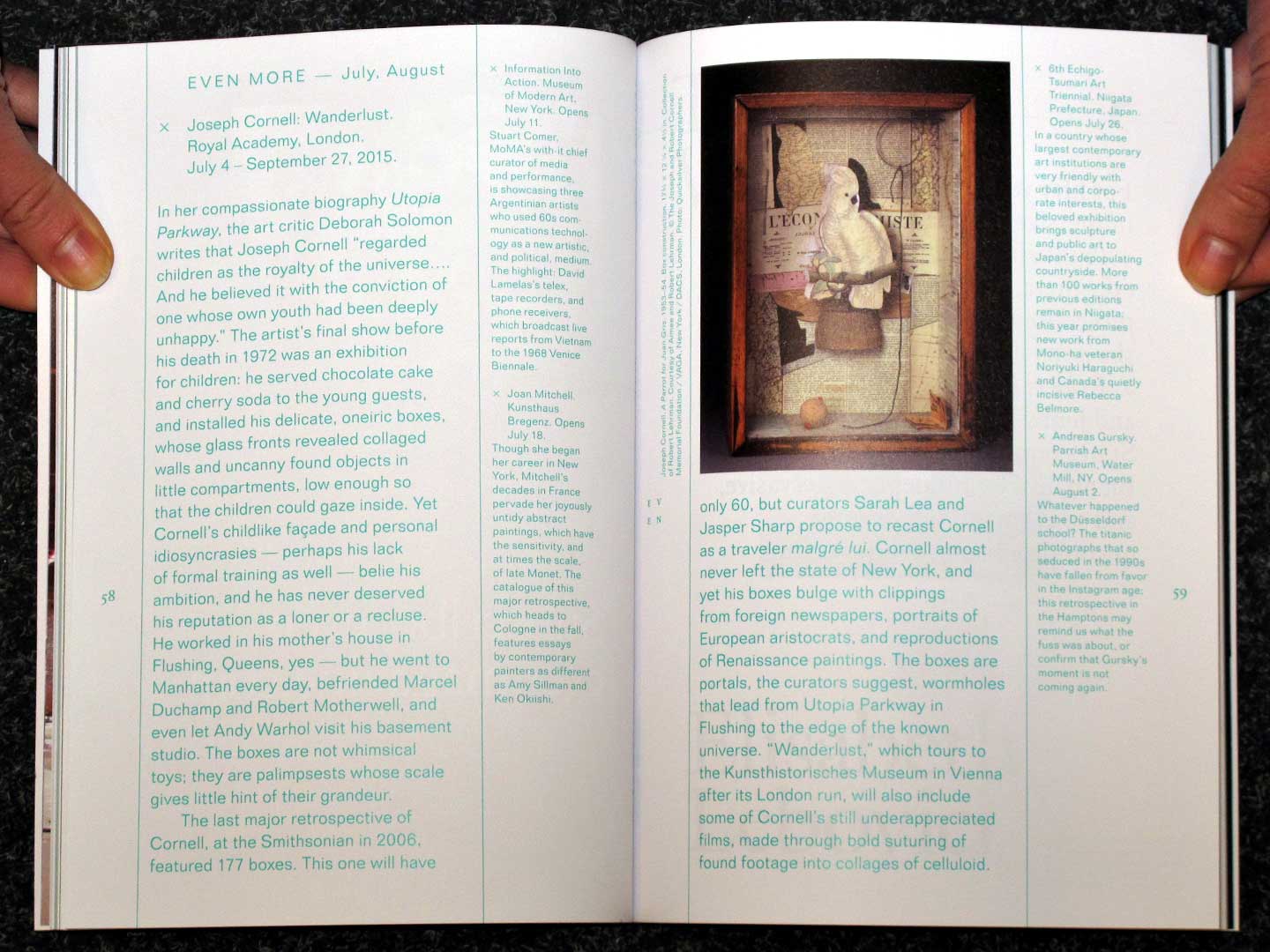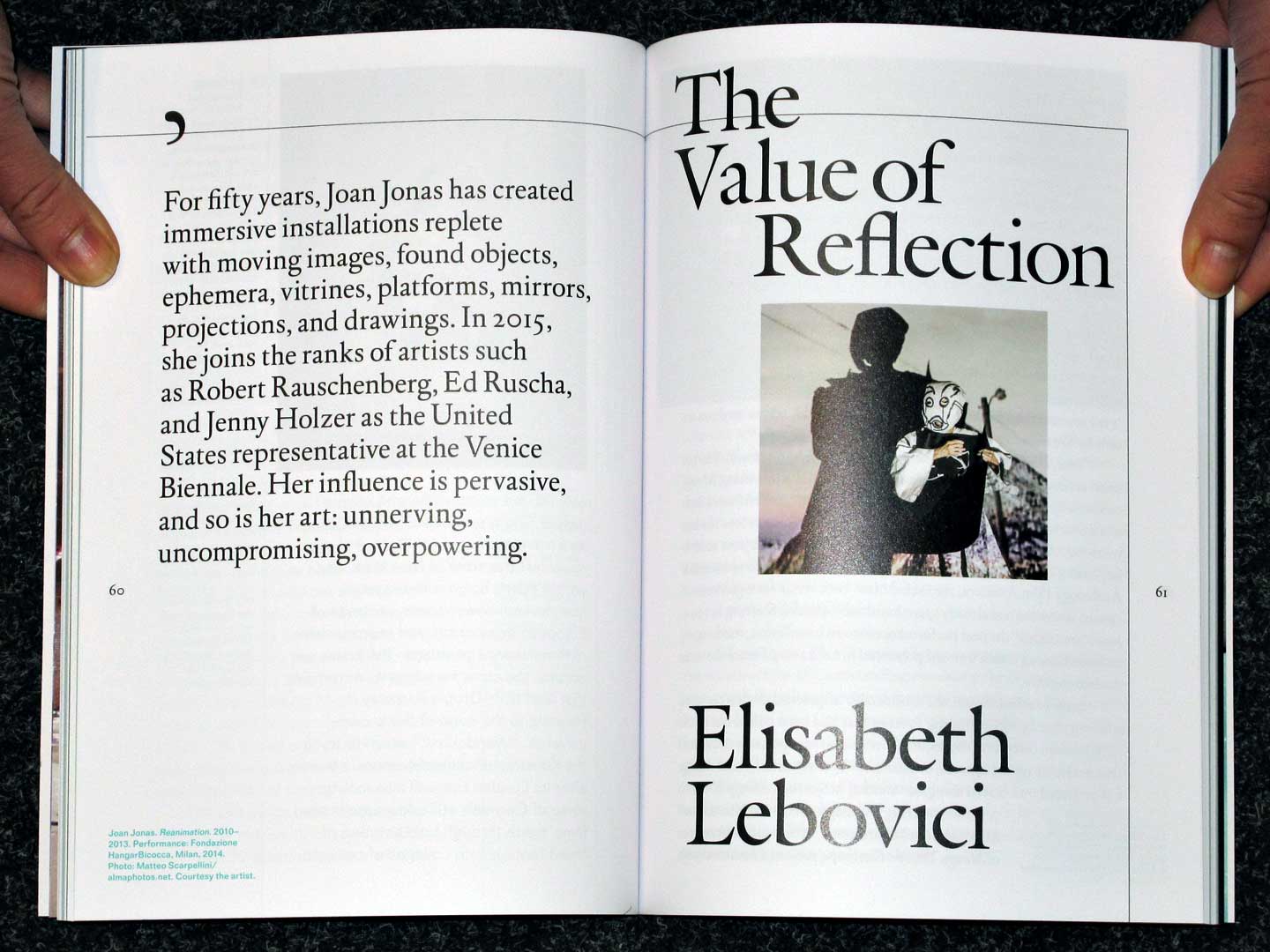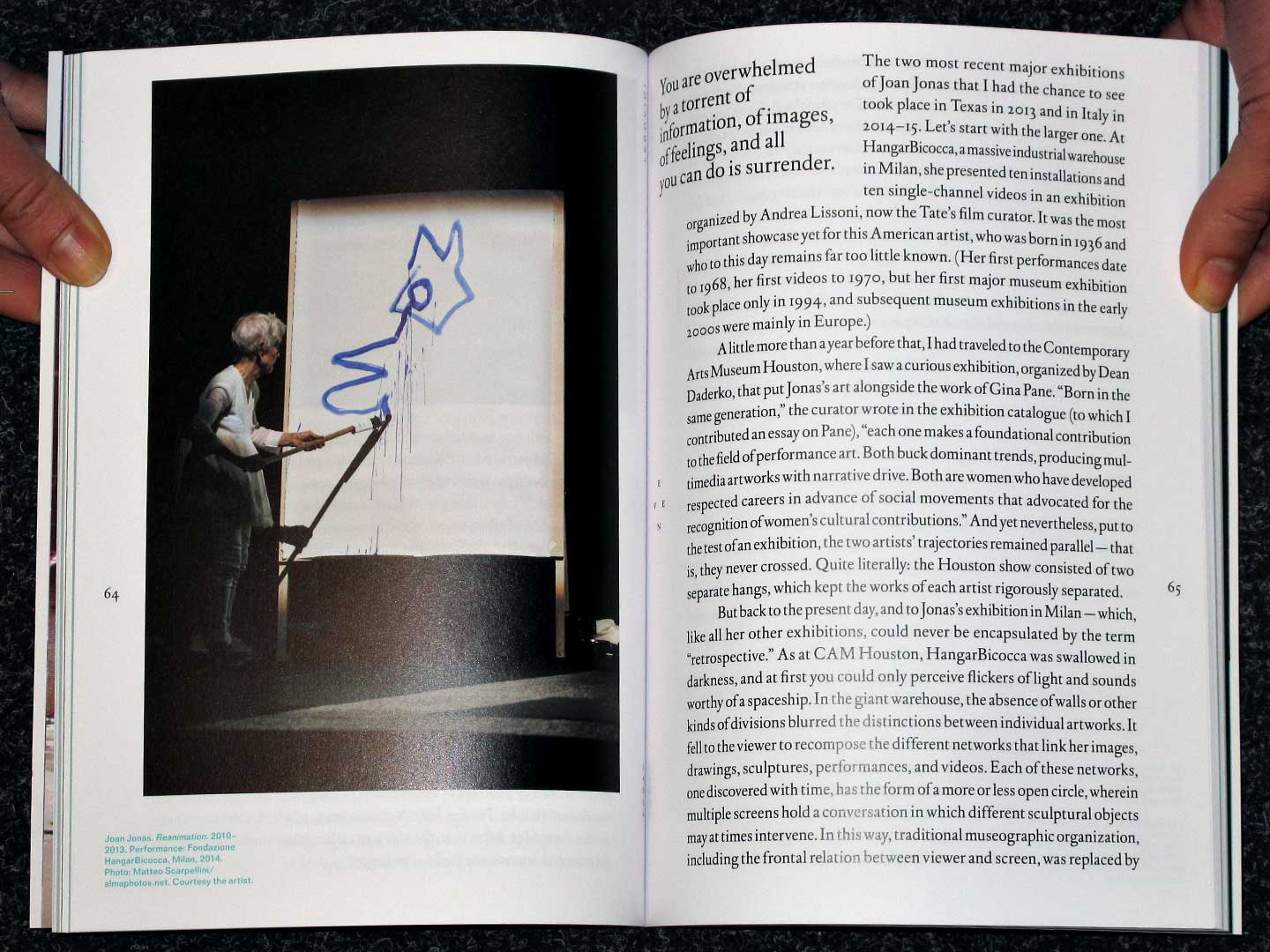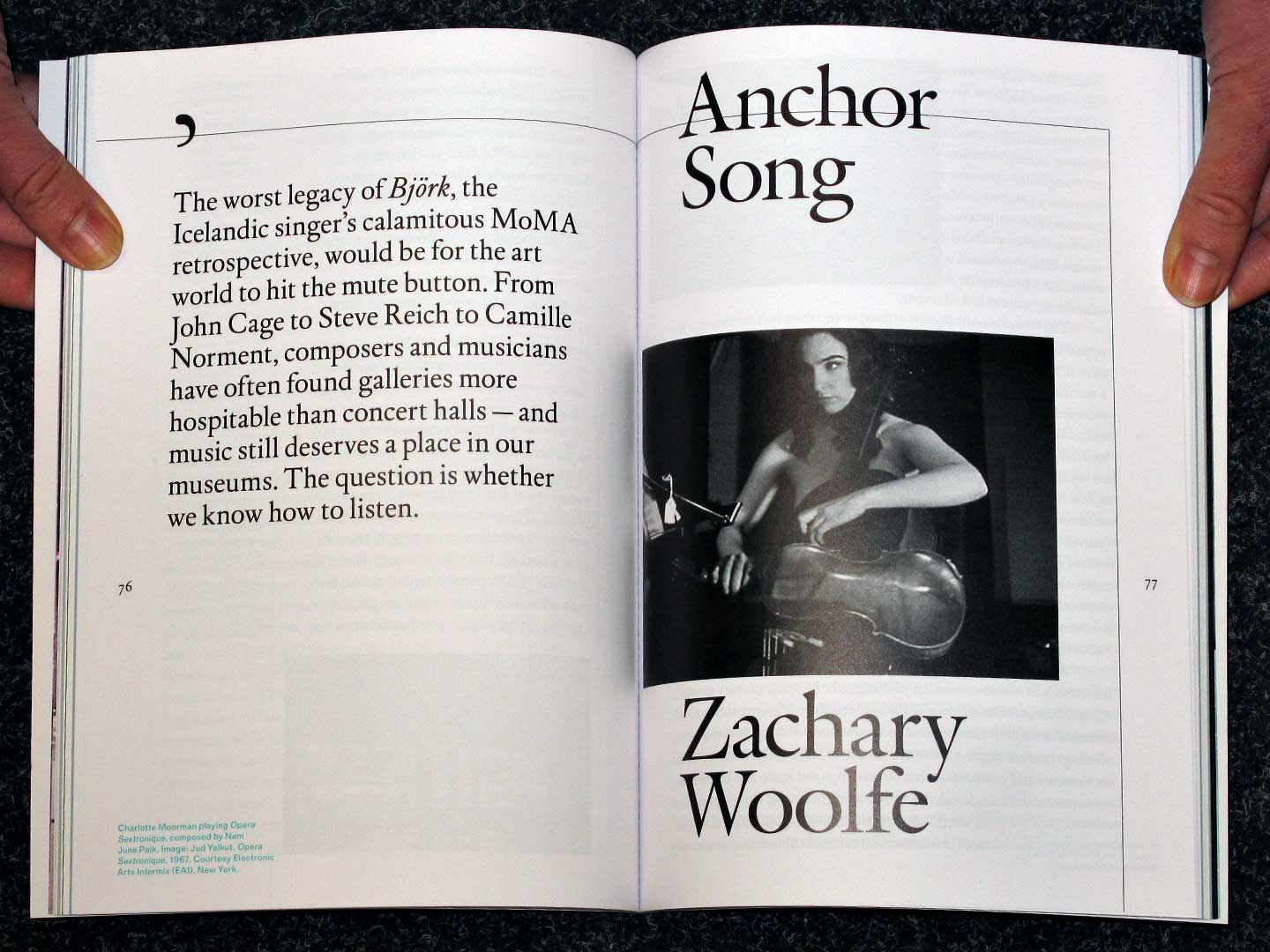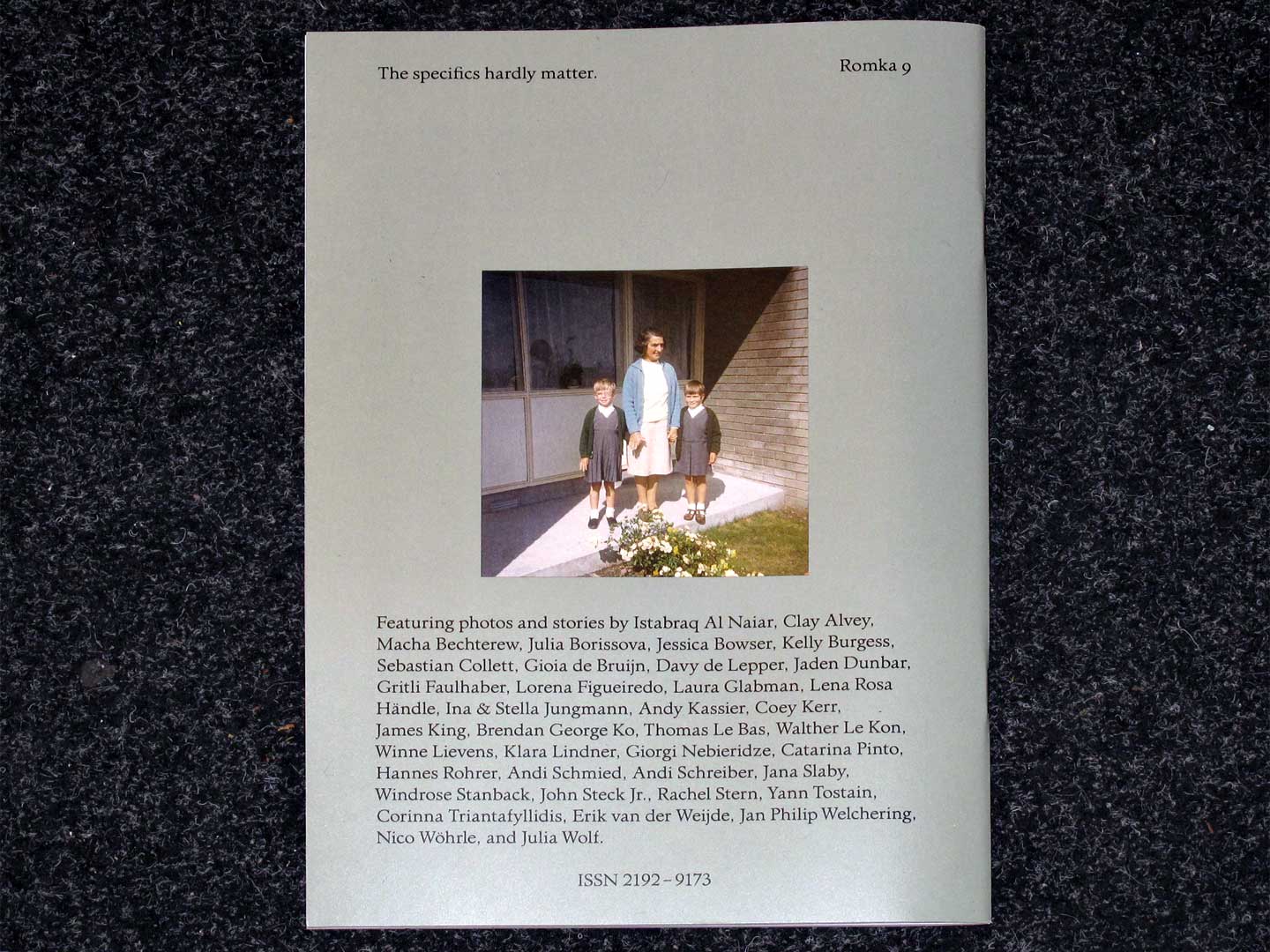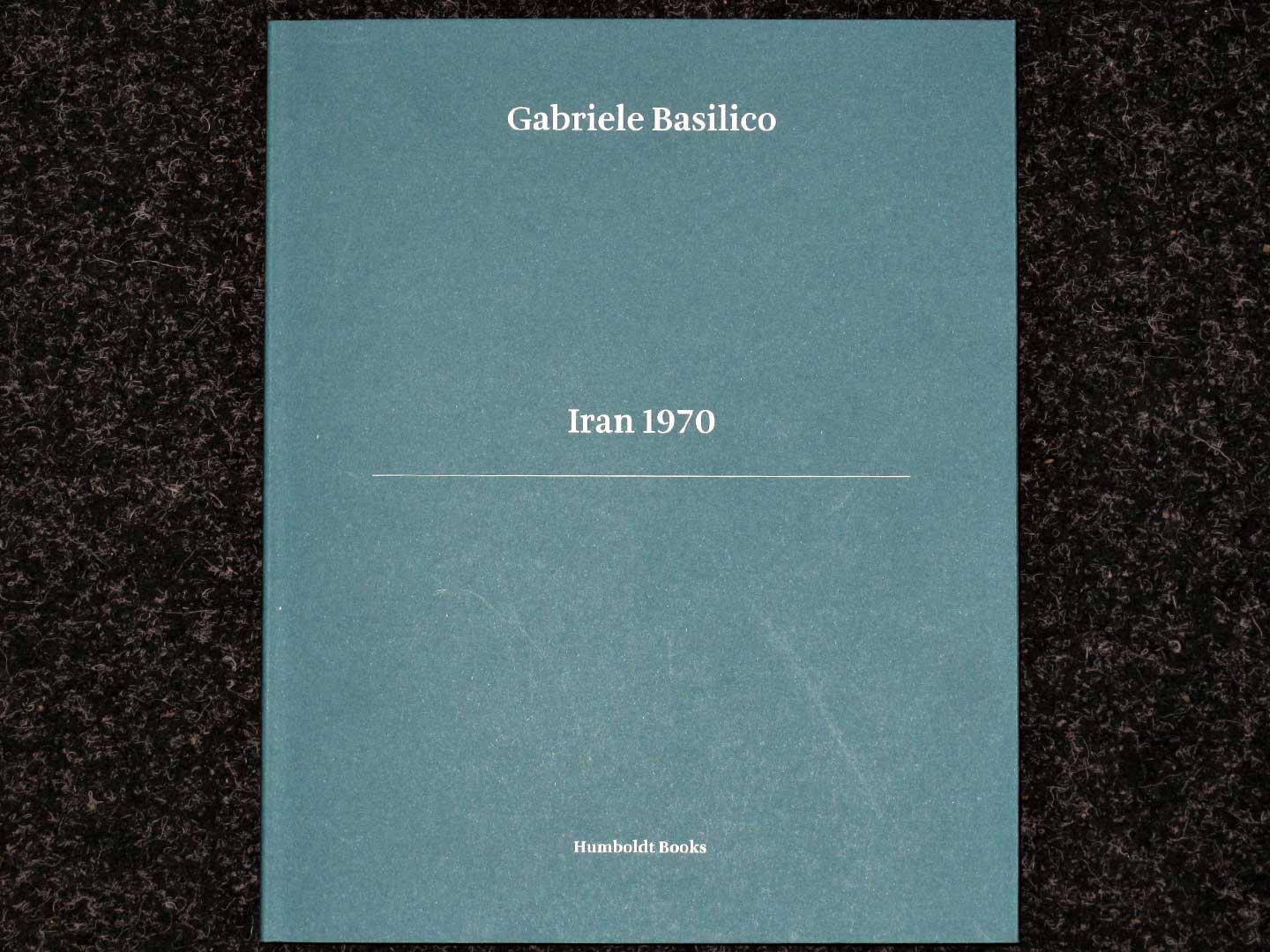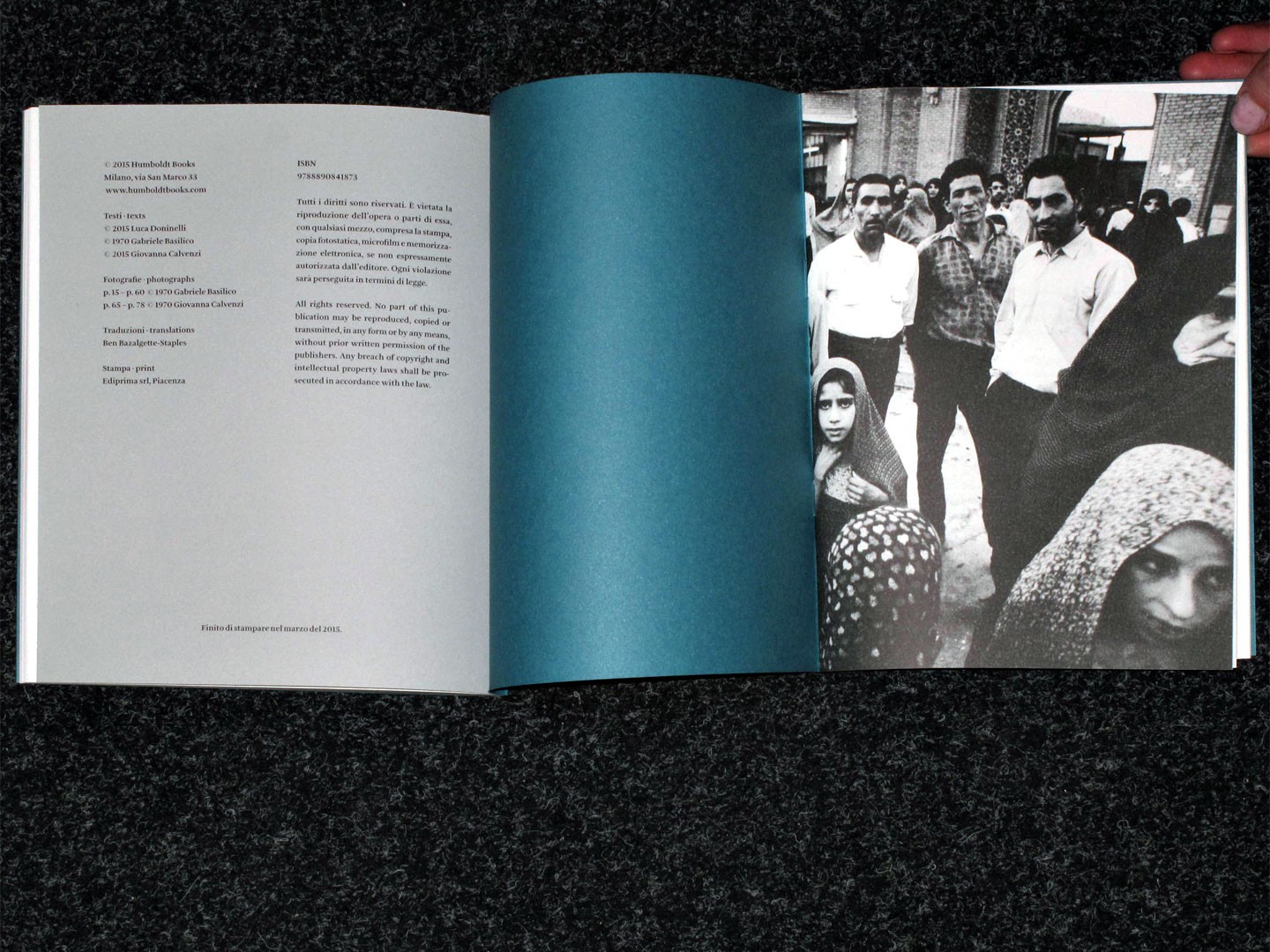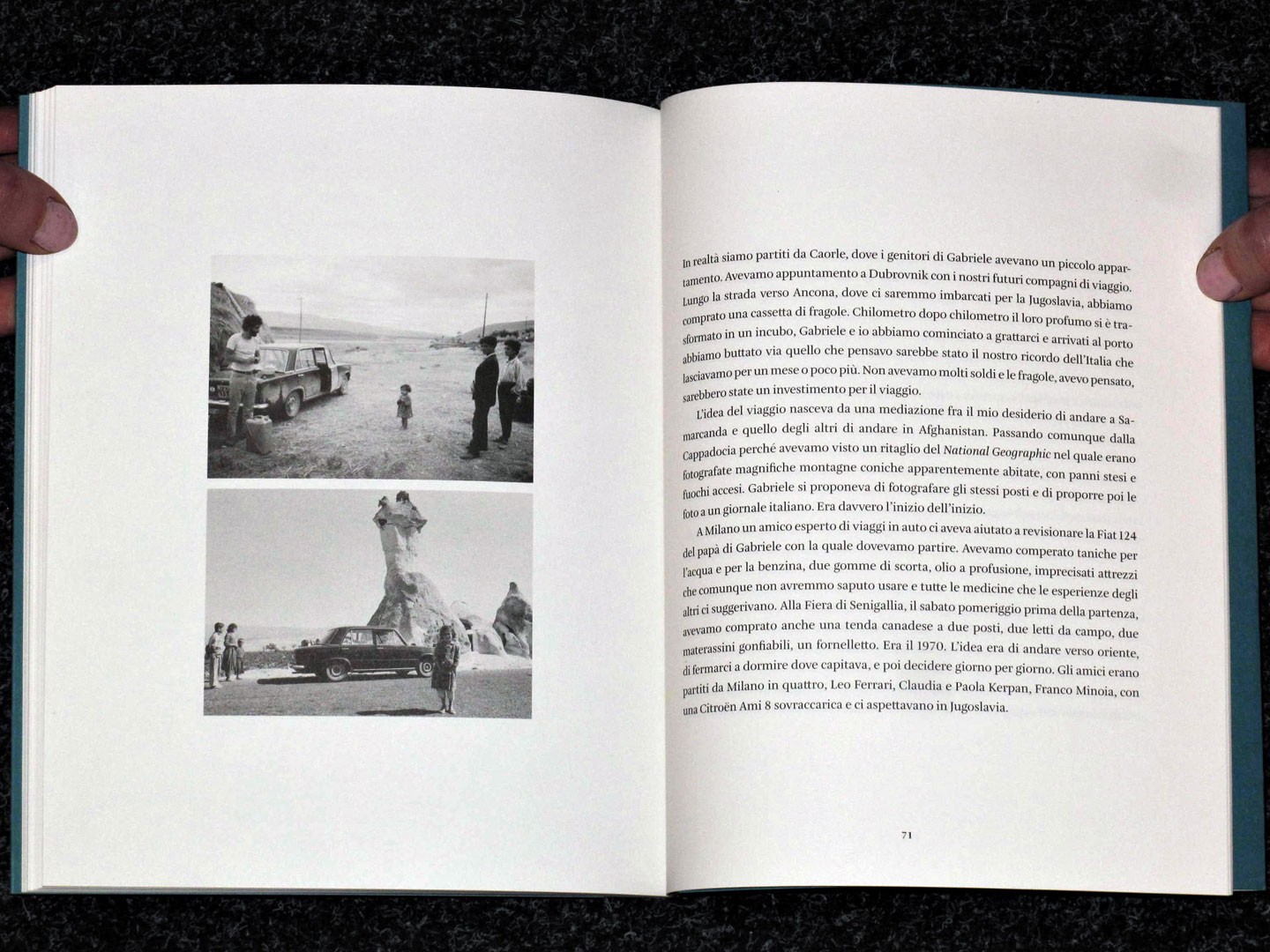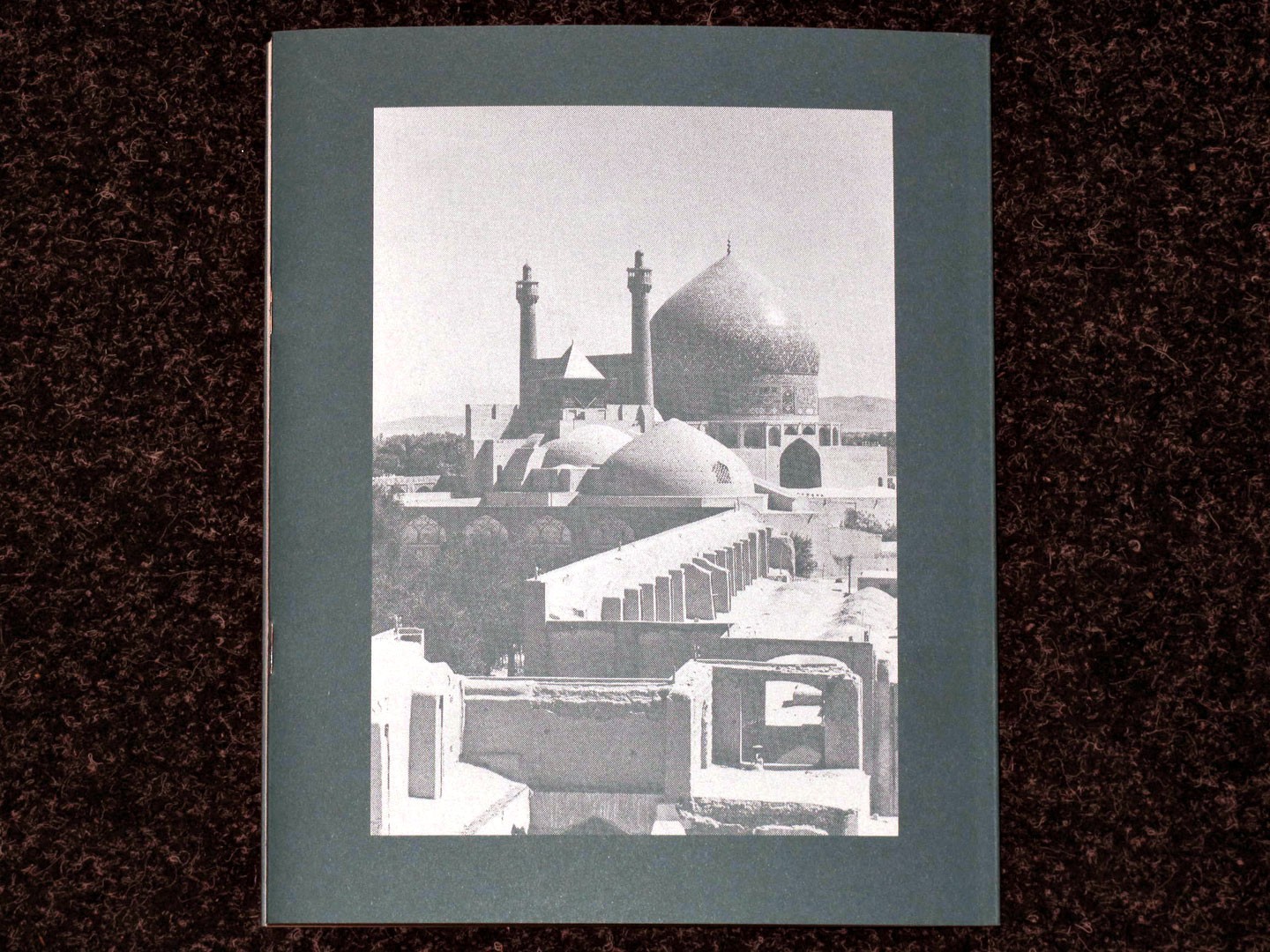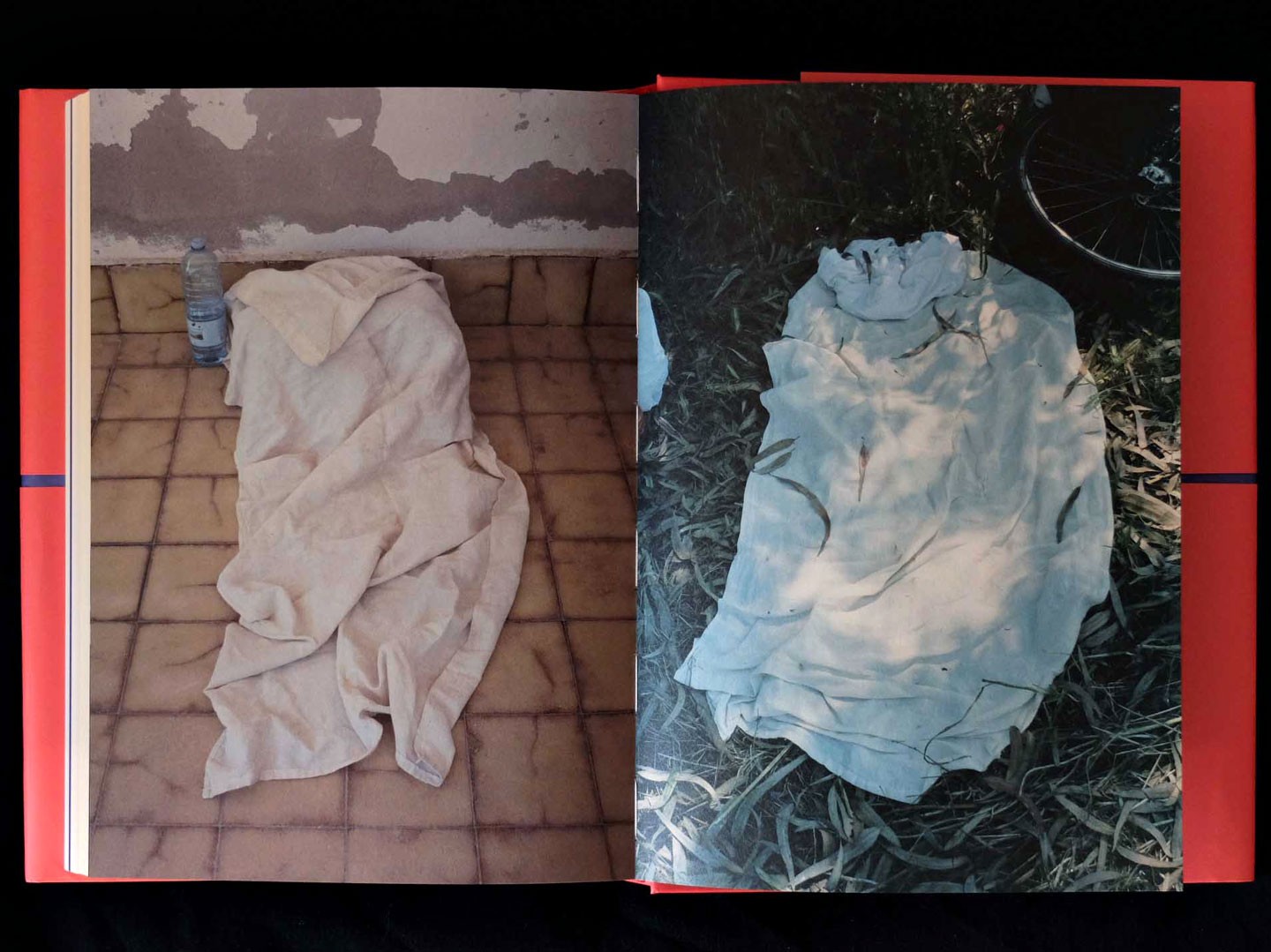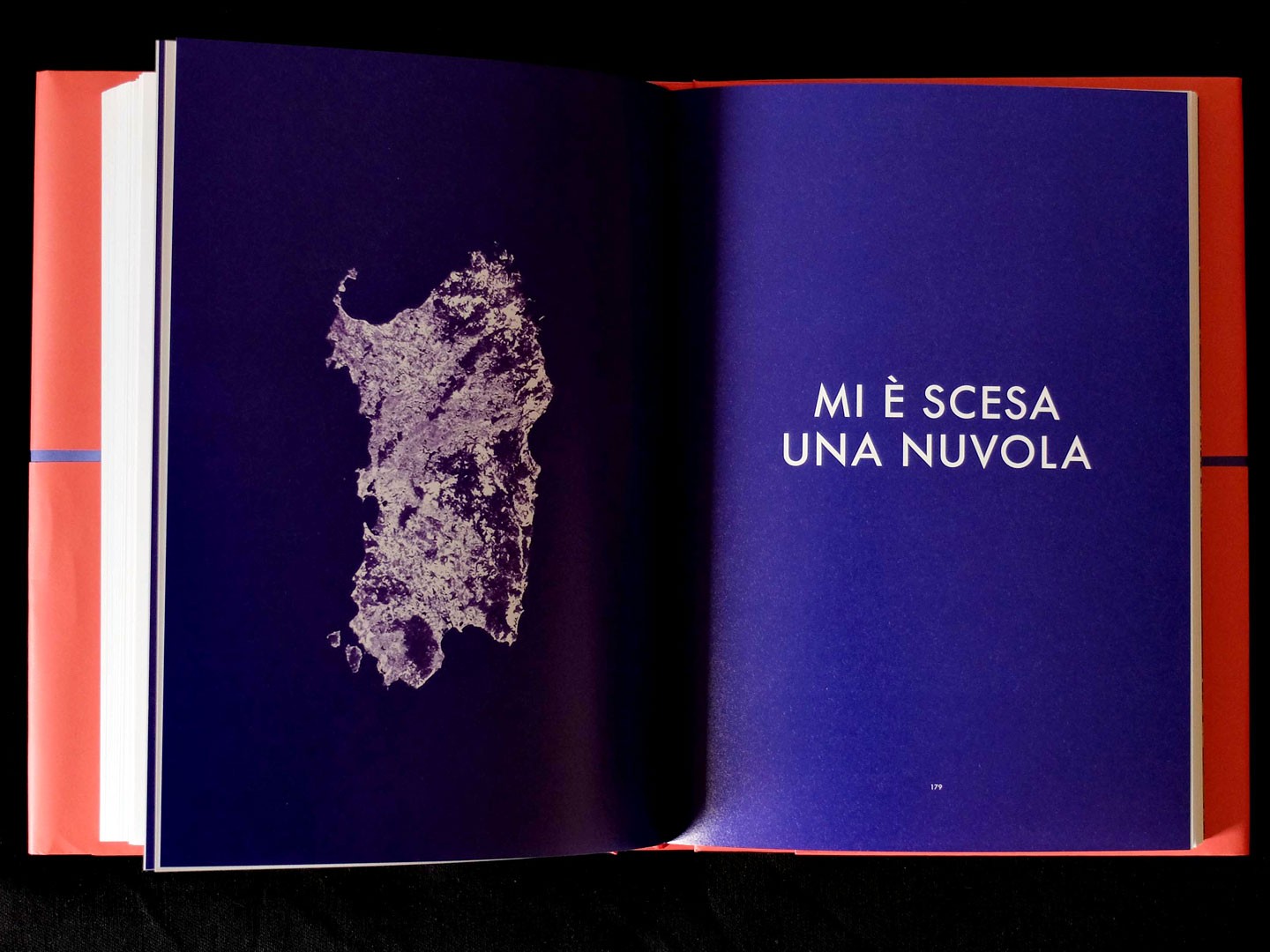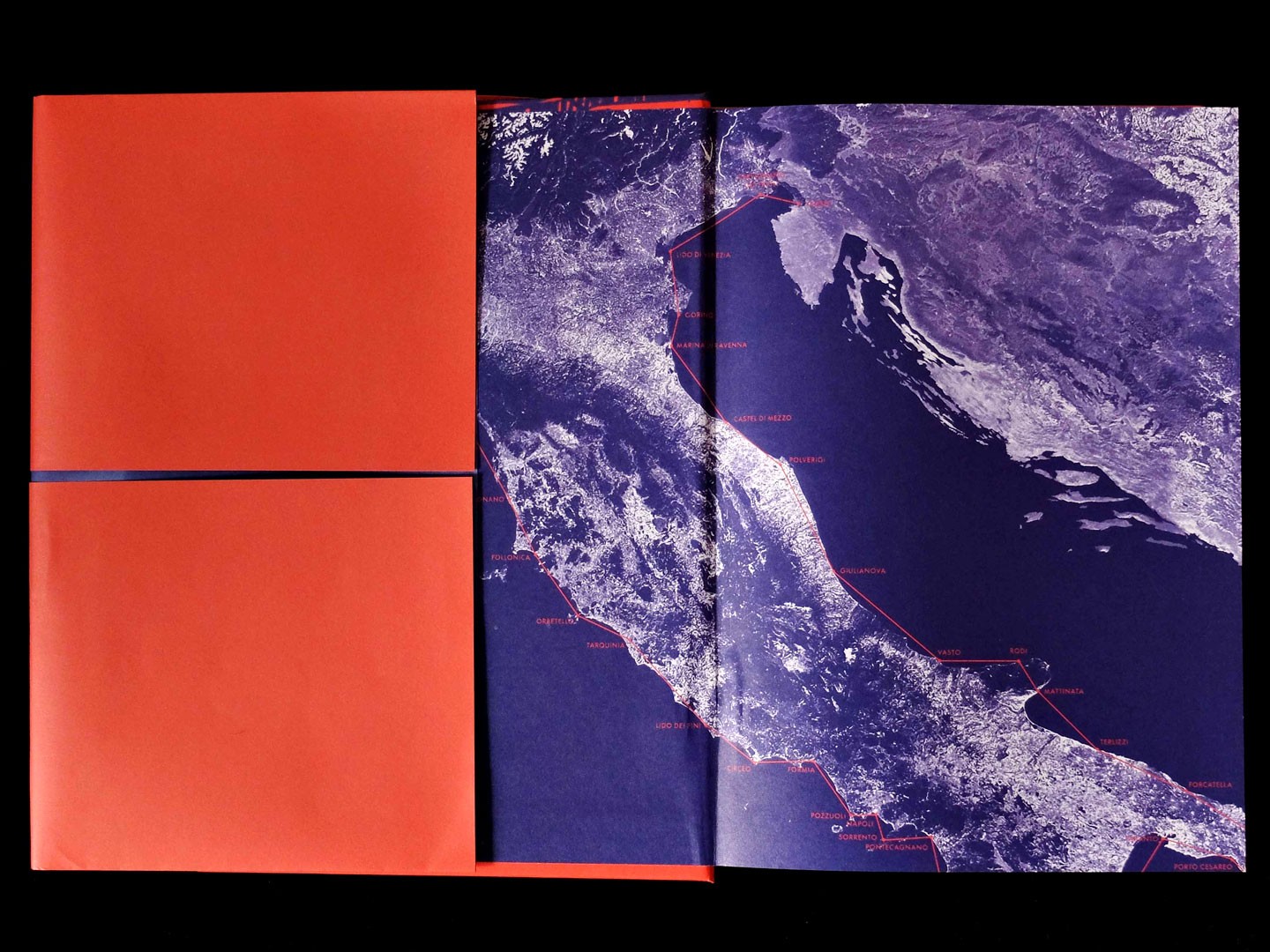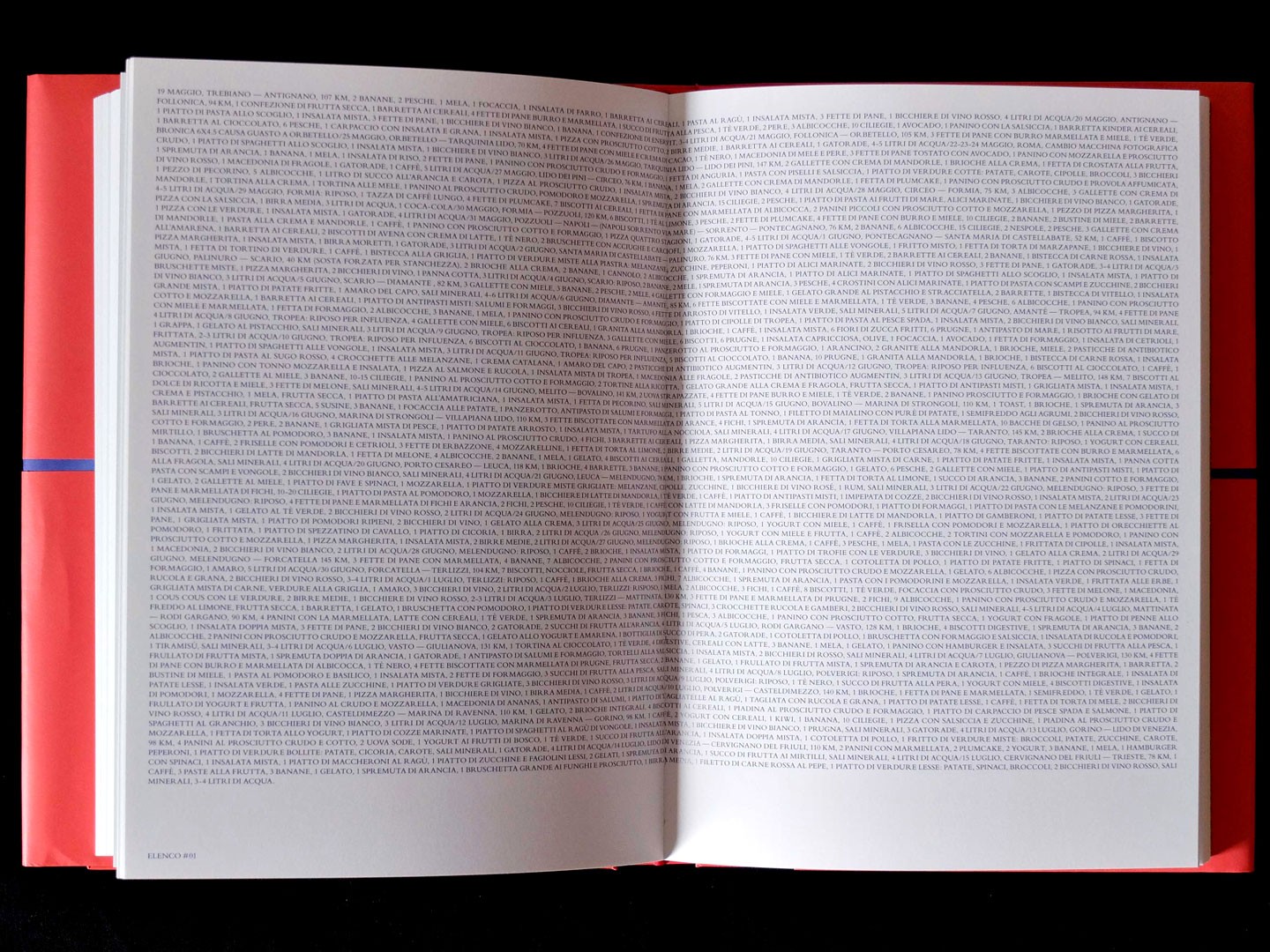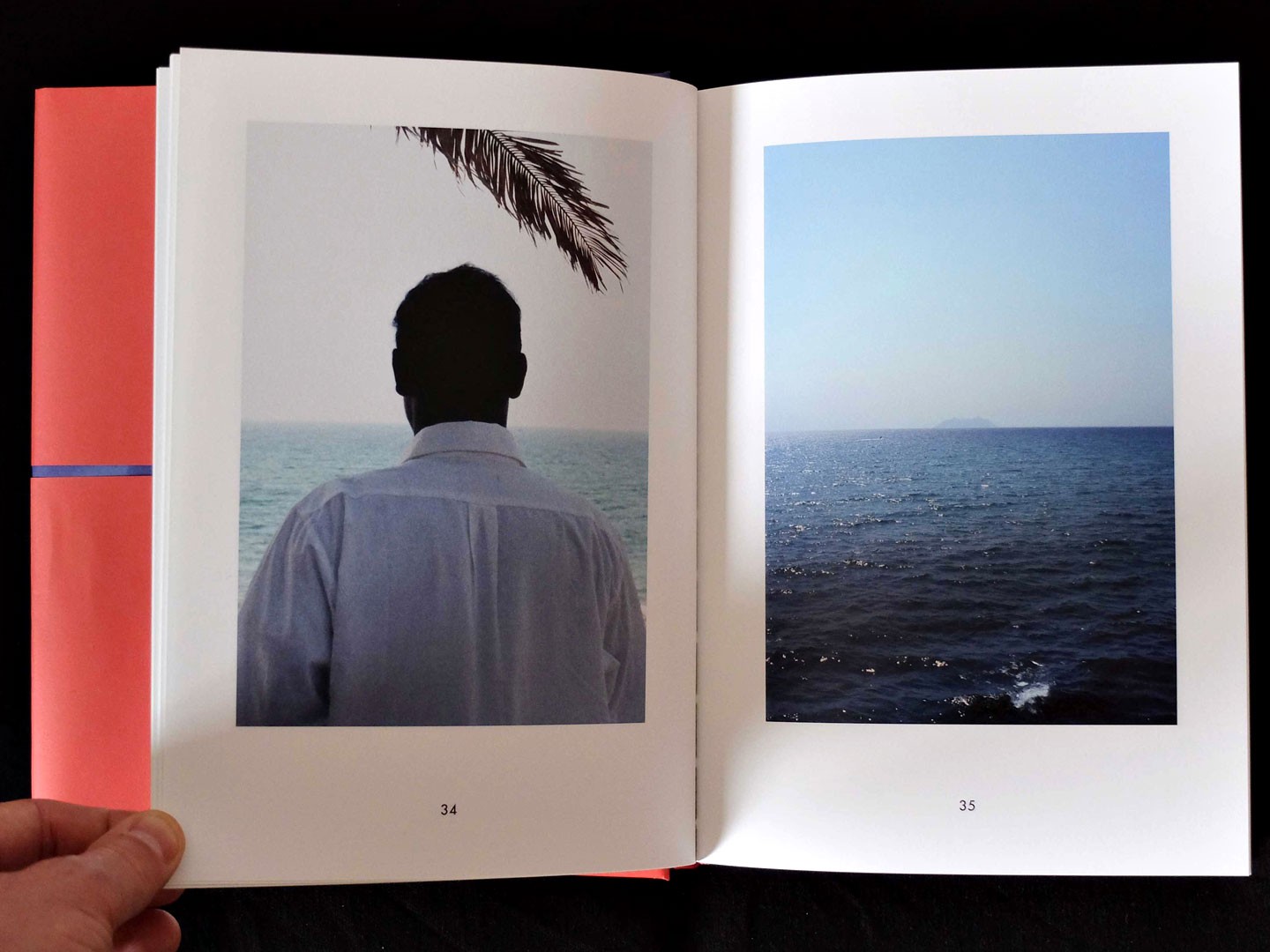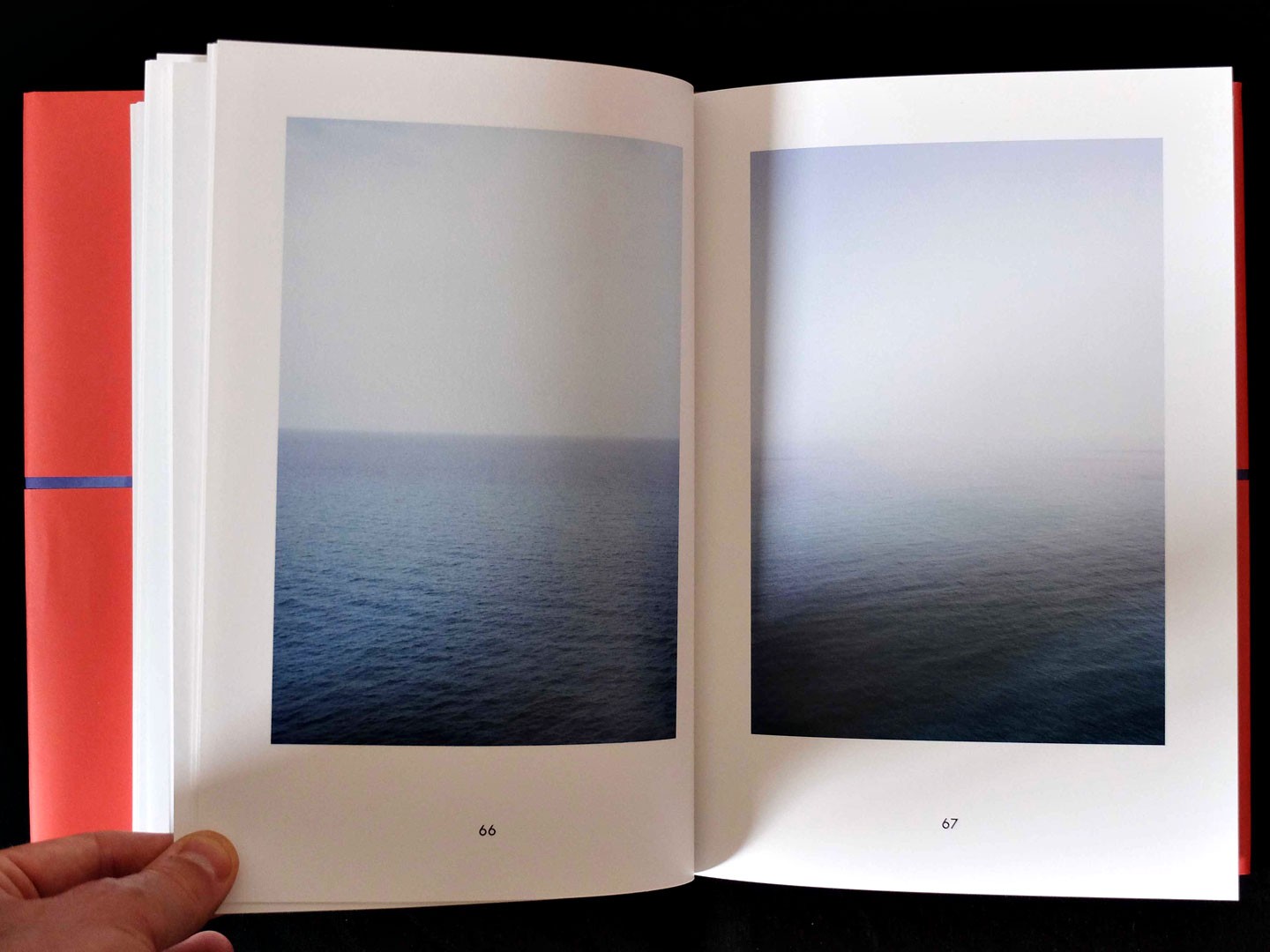
cura #19. Ilaria Marotta and Andrea Baccin (Eds.)
Posted in magazines on April 21st, 2015Tags: Andrea Baccin, cura., Ilaria Marotta
Sova #6 “Desire” takes a glimpse at the apparently essential query of the hedonistic generation – our bawdy cravings, our passionate endeavour and the destructiveness of our devouring needs. Various visual and textual reflections by 16 different photographers, writers and other artists including Anastasia Muna, Anna Crews, Archie Fitzgerald, Eylül Aslan, Florian Reimann, Helen Korpak, J Mauricio Orozco, Jasmin Kokkola, Lena Gallovicova, Marina Richter, Massimiliano Perasso, Nicolas Polli, Nicole Weniger, Ren Hang, Rebecca Brodskis and Slavoj Žižek create an encounter of disparate aspects of desire and investigate the nature of our ambiguous aspirations.
The Sova #6 Artist Poster by Atelier Disko with a quote from Slavoj Žižek. Comes with every freshly printed copy.
€14.00
Rick Buckley @ Motto Berlin. 25.04.2015
from 7pm
Four Corners Books Familiars series
The Nose by Nikolai Gogol art by Rick Buckley
Q&A: Rick Buckley, The Nose
In 1997 you anonymously fixed to-scale sculptural nose forms to buildings around central London. What was the idea behind this?
I was inspired by reading about the antics of the International Situationists operating in Paris during the late 1960s, carrying out sporadic artistic pranks as political gestures. The intervention involving the cast nose forms applied to specific interior / exterior locations within and around Central London, was a political gesture responding to a long running political debate over the obtrusive and ever growing numbers of CCTV surveillance cameras being installed within public spaces in and around the capital. This excess of surveillance was criticized as an infringement upon the rights to privacy of the individual citizen.
It was an afterthought whilst carrying out the intervention, that by integrating an applied form to a specific location, would over a period of time, become part of the structure it had been applied to. With the emergence of social network forums on the net, the small number of remaining nose forms have since become part of urban myth making. One such myth entitled The London Nose’, is centered around a Nose form located at Admiralty Arch. Various versions exist, but the first to appear was on a London Cab Driver’s blog, where he made numerous speculations for the nose’s existence. One explains that because of its position, it enables mounted horse guards to stroke it for good luck whilst on military duty whilst passing through the arch. It is now believed to feature in the London Cab Drivers examination (The Knowledge), thus prompting fledgling cab drivers to touch the nose for good luck before taking the exam and enabling them to receive their hard earned London Hackney Carriage License.
How does this street intervention fit in with the rest of your practice?
I’ve always been interested in the concept of myth making, which I often use as a conceptual pretext for my artistic practice.
How do you feel the project has changed now that it also exists in the form of photographs accompanying text?
It’s many years since I carried out the intervention and therefore I have a distance to it. It’s now out there on its own, belonging to the public, and therefore the book publication is extension of that public sphere.
How do you think the experience of reading this edition might compare with reading a version without images?
Well the human imagination is far more inventive than what already exists out there, but juxtaposing a 19th Century novella with a contemporary setting, may make the absurdity and pomposity of power more vivid.
Were there any challenges in working in response to a story by such an influential author?
No, because both works were responding to absurdities of authority and criticising the powers that be. And there are certainly no challenges in regards to the obstacles relating to copyright law, as it’s outside the 70 years remit. Actually, current Russian copyright law stipulates that all copyrights to works published prior to October Revolution (7th November 1917) are believed to have expired.
Mousse #48 includes:
The Artist as Curator
Issue #7 an insert in Mousse Magazine #48
(Available in the international edition and for subscription only)
Quatre grenouilles apparaissent en négatif et déambulent parmi les pages du livre. 4 Frogs est un jeu formel, qui contraste avec le reste du travail de Jochen Lempert. Biologiste de formation, il entreprend dans son oeuvre photographique une patiente observation de la nature, tout en témoignant et mettant en perspective nos représentations du monde organique. Par une approche évoquant Jean Painlevée, il propose ici un regard à la fois nouveau et archaïque sur l’animal, dont les mouvements semblent émaner de la page. Fixés dans un déplacement chaotique, les reflets des batraciens s’organisent pourtant sous notre regard en des sortes de constellations, en une organisation presque sensible et qui indique à notre vue la frontière de notre compréhension du vivant. DV
Ce livre a été réalisé en accompagnement de l’exposition ONYCHOPHORA, qui s’est tenue à art3
(Valence, Fr) en novembre 2010.
“When it comes to pop music, conceptual art, audacious positioning, and fierce artistic independence, there is simply no way around Bill Drummond. The KLF, The Timelords, The Justified Ancients of Mu Mu (J.A.M.S.), The K Foundation, The 2K, K2 Plant Hire Ltd. – these were all projects that aimed to attack established pop practices by means of easily-acquired sampling technology. Bill ceased being interested in the pop business a long time ago. Nonetheless, music is still at the centre of his current endeavours. The present book is a summary of his recorded lecture at Spoiler, MuseumsQuartier Vienna 2002, which for the past thirteen years has been available only as a single-copy library DVD. Despite the fact that Bill is loath to look back at the past and always directs his focus to the here and now, or rather because of this, I deemed it necessary to highlight his vast artistic range, development, and process of the last thirty years by means of this contemporary document and to present it to a younger generation. For the concept of time plays a special role in Drummond’s work. Whether as The Timelords, or in songs like ‘What Time is Love?’ or ‘3 A.M. Eternal,’ or via metaphorical numbers like 23, 33 ⅓, or 45, or his current World Tour 2014-2025 Bill has always thought, planned, acted, and reacted in structural time periods”. Robert Jelinek
€9.90
Using painting, drawing, and abstraction as markers of a space outside verbal description, Jessica Dickinson examines the slow exchanges between perception, matter, and psychology that develop in peripheral spaces. Each of her works is developed slowly, meditatively, through procedures that work toward a compressed measure of time that echoes the shifts in what is seen, both inwardly and outwardly.
Under / Press. / With-This / Hold- / Of-Also / Of/How / Of-More / Of:Know presents eight paintings and their “remainders”—graphite rubbings made of the paintings. Every time the surface of the paintings changes significantly, a graphite impression is made to transcribe the surface. These works in turn map the transitive passages of the paintings, becoming their indexes, unfolding time in a sequence while asserting the materiality of the paintings.
Published in conjunction with an exhibition at James Fuentes Gallery, New York, the book’s 46 color and 107 b&w reproductions are accompanied by an essay by curator Debra Singer and an interview with the artist by Patricia Treib.
€45.00
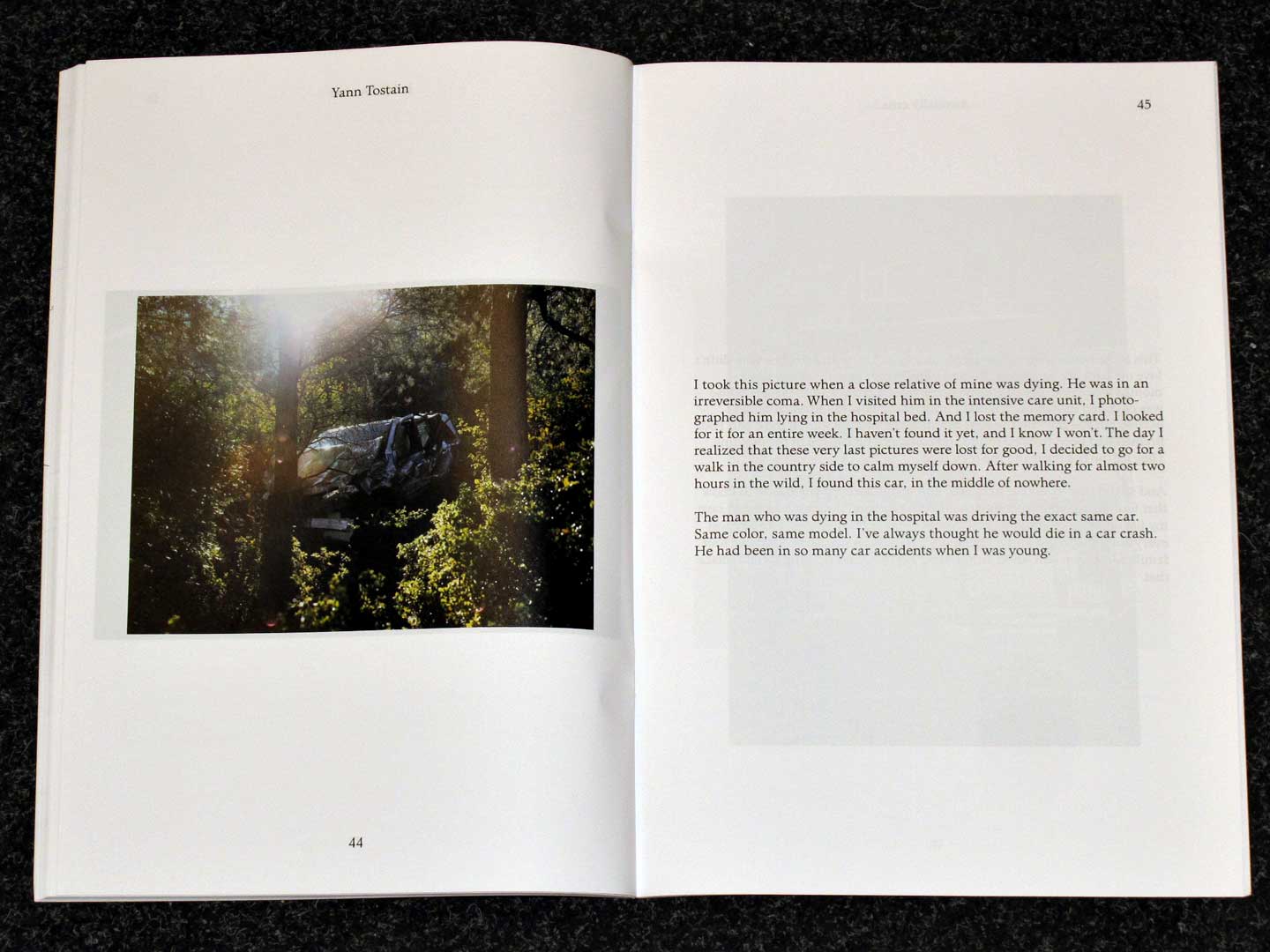
An ensemble which contends that the meaning of the Anthropocene is less a geological re-formation than it is trans-formation of both land and animal; once exposed to some of the parameters defining this transition, the reader-as-exhibition-viewer may begin to discern erratic rhythms generated by the creatures of nonconformity that inhabit, with their violence, struggles, and love the vast, machinic reality called Earth.
Land & Animal & Nonanimal turns the attention from the built space of cultural repositories to the postnatural landscapes of planet Earth. In his interview about urban soils of the Anthropocene, landscape architect Seth Denizen considers a history of land use practices that is also reflected in artist Robert Zhao Renhui’s photographs of Singapore as a scenario of continuous development. Inspired by a recent visit to the environment of Wendover in the Utah desert, Richard Pell and Lauren Allen of Pittsburgh’s Center for PostNatural History make a case for a postnatural imprint upon the geologic aspects inherent in the concept of the Anthropocene. By encountering “the last snail,” environmental historian and philosopher Thom van Dooren considers the meaning of hope and care in the context of species extinction. And while curator Natasha Ginwala’s paginated series with contributions by Bianca Baldi, Arvo Leo, Axel Staschnoy, and Karthik Pandian & Andros Zins-Browne turns to cosmological and ancestral human-animal scenarios, sound artist and researcher Mitchell Akiyama explores philosophies of consciousness against the background of the phonogram in nineteenth-century simian research.
Co-edited by Anna-Sophie Springer & Etienne Turpin
Design by Katharina Tauer
13 color + 39 black/white images
€15.99
Fantasies of the Library
… is a sequence of pages wherein the reader-as-exhibition-viewer learns, rather surprisingly—but with growing conviction—that the library is not only a curatorial space, but that its bibliological imaginary is also a fertile territory for the exploration of paginated affairs in the Anthropocene.
Fantasies of the Library inaugurates the intercalations: paginated exhibition series. Virtually stacked alongside Anna-Sophie Springer’s feature essay “Melancholies of the Paginated Mind” about unorthodox responses to the institutional ordering principles of book collections, the volume includes an interview with Rick Prelinger and Megan Shaw Prelinger of the Prelinger Library in San Francisco; reflections on the role of cultural memory and the archive by Hammad Nasar, Head of Research and Programmes at the Asia Art Archive, Hong Kong; a conversation with media theorist Joanna Zylinska about experiments on the intersections of curatorial practice and open source e-books; and a discussion between K’s co-director Charles Stankievech and platform developer Adam Hyde on new approaches to open source publishing in science and academia. The photo essay, “Reading Rooms Reading Machines,” presents views of unusual historical libraries next to works by artists such as Kader Attia, Andrew Beccone, Mark DFantasies of the Libraryion, Rodney Graham, Katie Paterson, Veronika Spierenburg, Andrew Norman Wilson, and others.
published by K. Verlag, Haus der Kulturen der Welt
Paperback, thread-bound, 160 pages
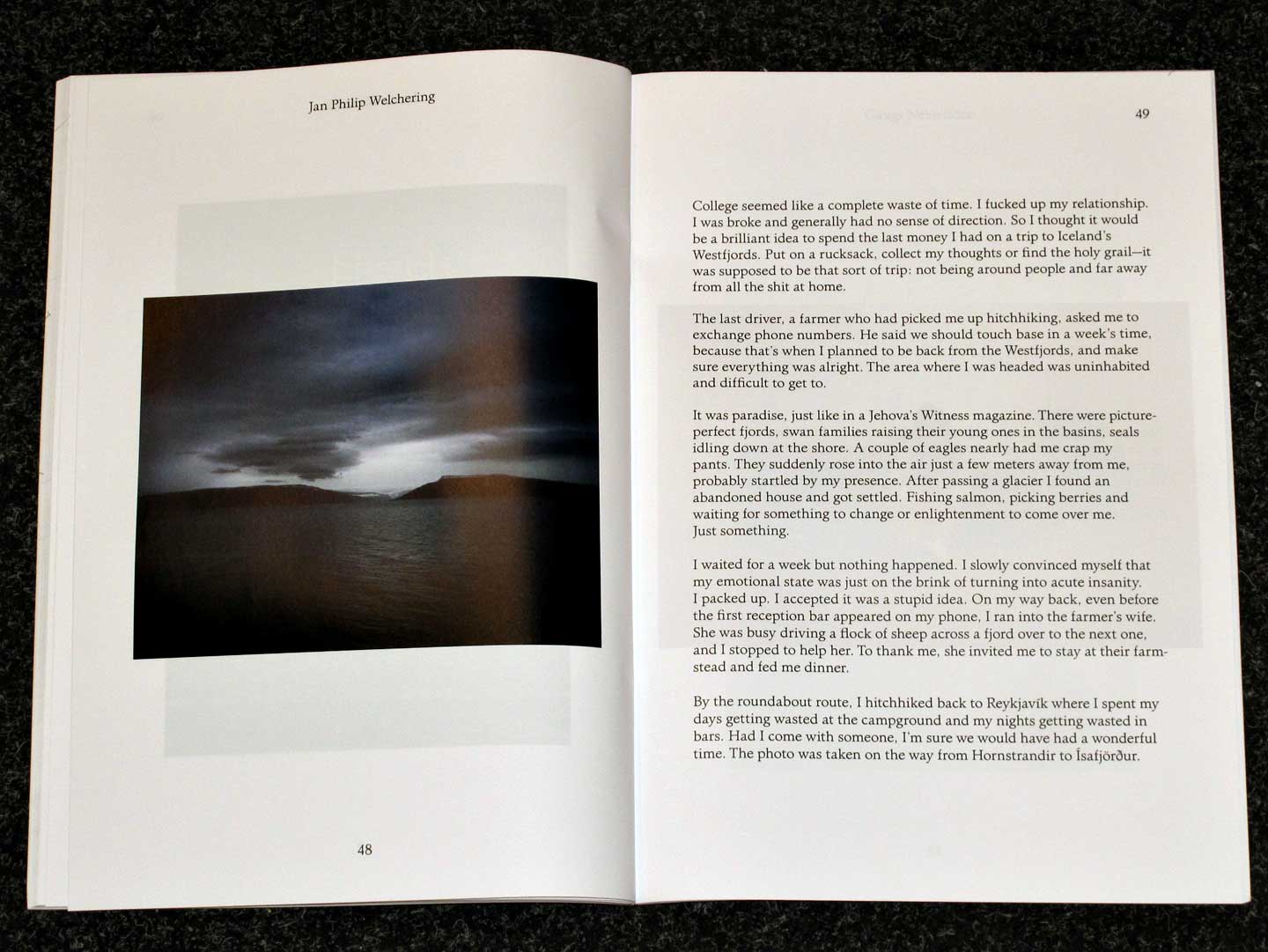
30 color + 15 black/white images
ISBN: 9780993907401
15.99€
Buy it