
Convolution Journal for Critical Experiment #1
Posted in magazines, writing on July 21st, 2012 by adminTags: Convolution Journal for Critical Experiment
Convolution Journal for Critical Experiment
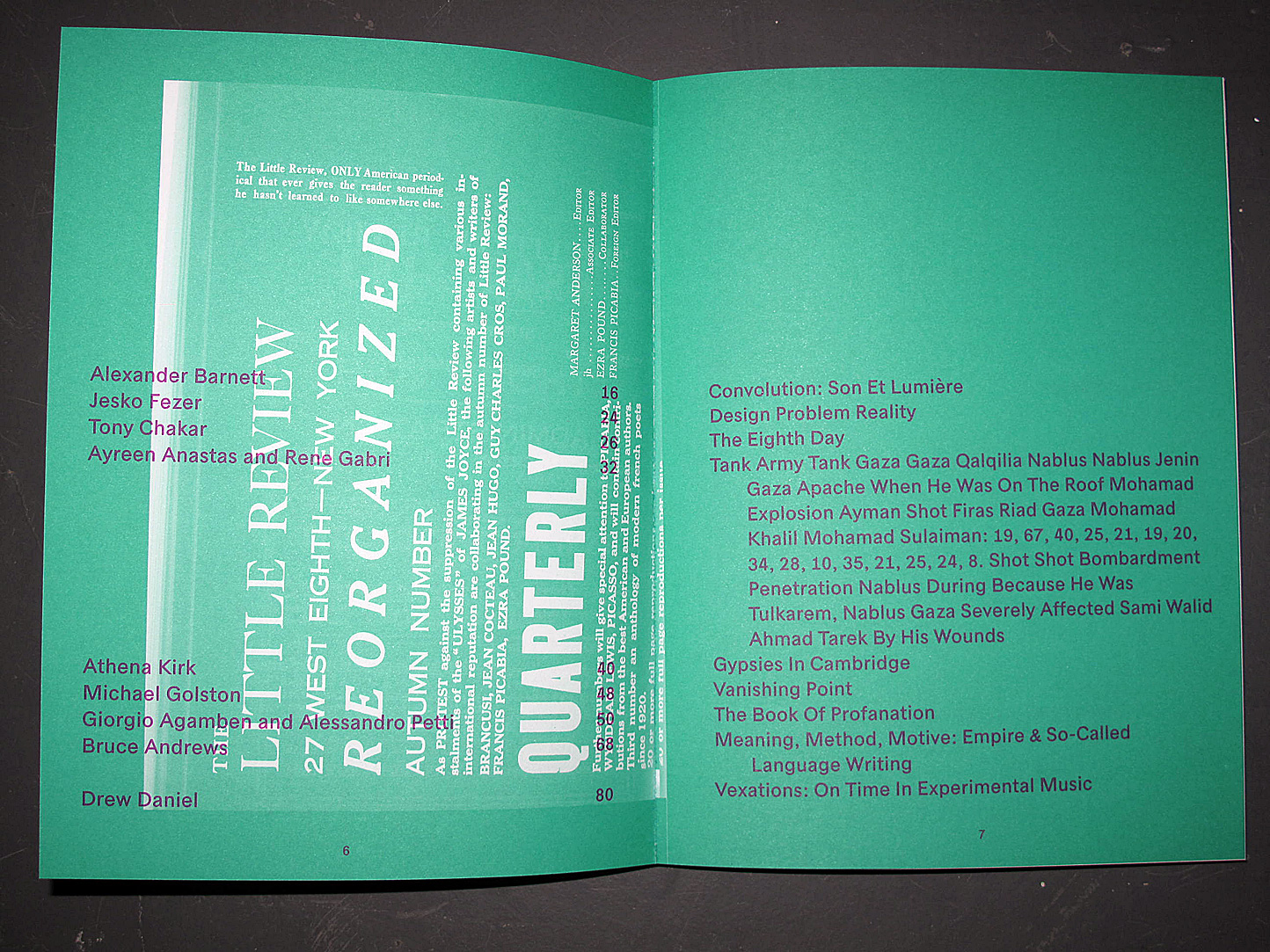
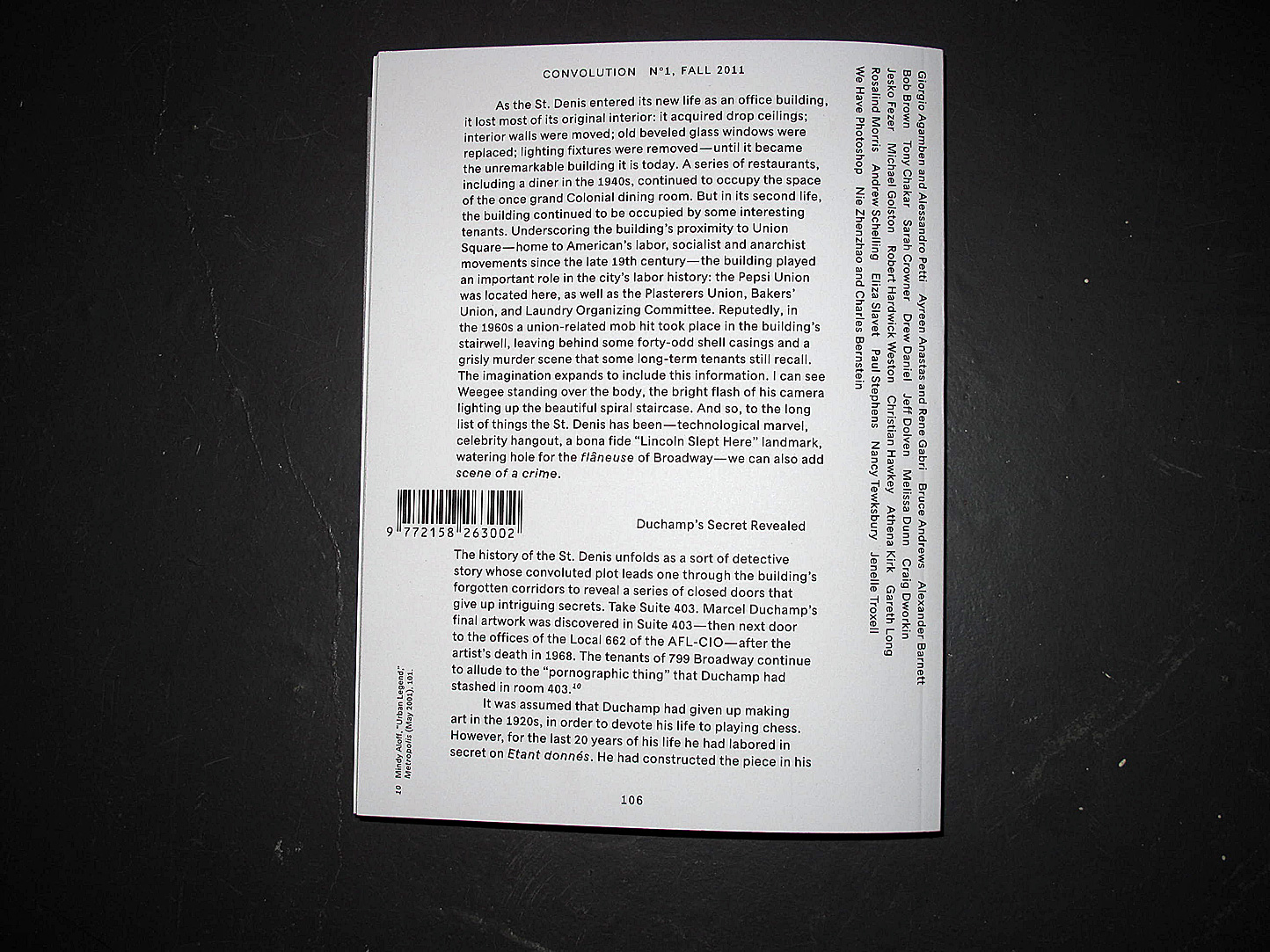
contributions by: Giorgio Agamben and Alessandro Petti Ayreen Anastas and Rene Gabri Bruce Andrews Alexander Barnett Bob Brown Tony Chakar Sarah Crowner Drew Daniel Jeff Dolven Melissa Dunn Craig Dworkin Jesko Fezer Michael Golston Robert Hardwick Weston Christian Hawkey Athena Kirk Gareth Long Rosalind Morris Andrew Schelling Eliza Slavet Paul Stephens Nancy Tewksbury Jenelle Troxell We Have Photoshop Nie Zhenzhao and Charles Bernstein
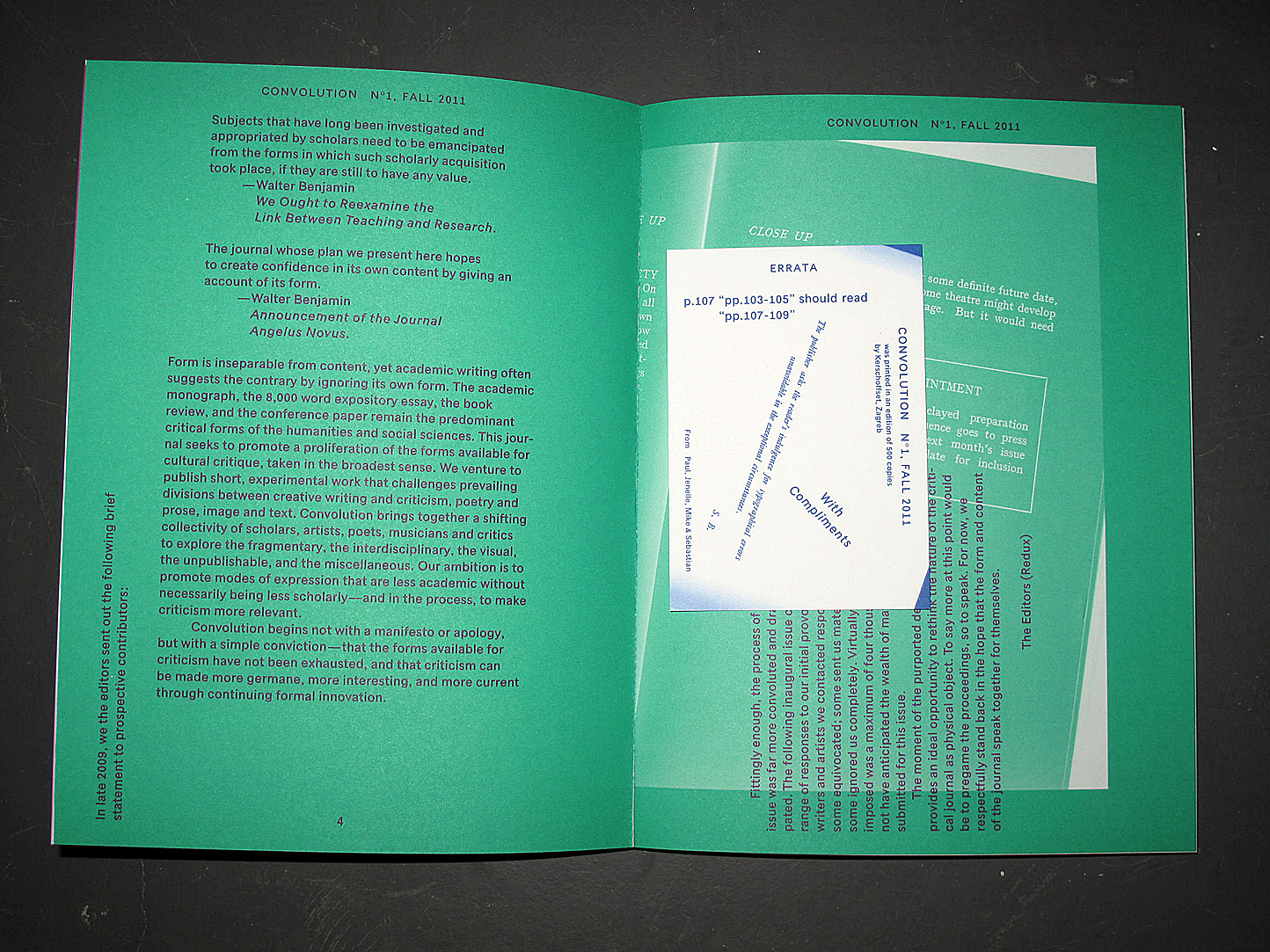
Convolution began with the following brief statement to prospective contributors:
Subjects that have long been investigated and appropriated by scholars need to be emancipated from the forms in which such scholarly acquisition took place, if they are still to have any value.
Walter Benjamin, We Ought to Reexamine the Link Between Teaching and Research.
The journal whose plan we present here hopes to create confidence in its own content by giving an account of its form.
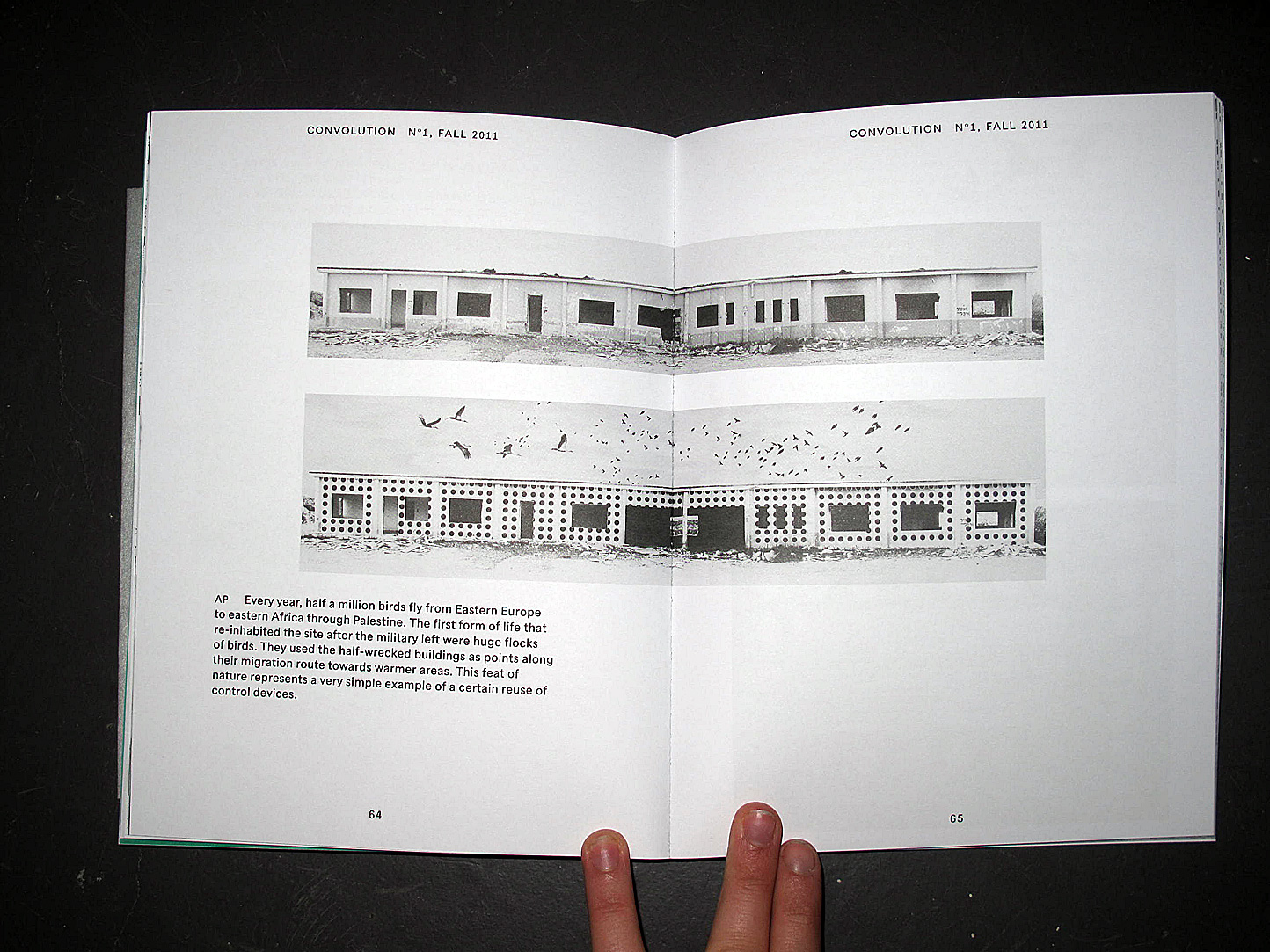
Walter Benjamin, Announcement of the Journal Angelus Novus.Form is inseparable from content, yet academic writing often suggests the contrary by ignoring its own form. The academic monograph, the 8,000 word expository essay, the book review, and the conference paper remain the predominant critical forms of the humanities and social sciences. This journal seeks to promote a proliferation of the forms available for cultural critique, taken in the broadest sense. We venture to publish short, experimental work that challenges prevailing divisions between creative writing and criticism, poetry and prose, image and text. Convolution brings together a shifting collectivity of scholars, artists, poets, musicians and critics to explore the fragmentary, the interdisciplinary, the visual, the unpublishable, and the miscellaneous. Our ambition is to promote modes of expression that are less academic without necessarily being less scholarly—and in the process, to make criticism more relevant.
Convolution begins not with a manifesto or apology, but with a simple conviction—that the forms available for criticism have not been exhausted, and that criticism can be made more germane, more interesting, and more current through continuing formal innovation.
Fittingly enough, the process of assembling the first issue was far more convoluted and drawn out than we anticipated. The following inaugural issue contains an eclectic range of responses to our initial provocation. Some of the writers and artists we contacted responded immediately; some equivocated; some sent us material that didn’t fit; some ignored us completely. Virtually the only constraint we imposed was a maximum of four thousand words. We could not have anticipated the wealth of material generously submitted for this issue.
The moment of the purported demise of print culture provides an ideal opportunity to rethink the nature of the critical journal as physical object. To say more at this point would be to pregame the proceedings, so to speak. For now, we respectfully stand back in the hope that the form and content of the journal speak together for themselves.
Deprecated: link_pages is deprecated since version 2.1.0! Use wp_link_pages() instead. in /home/clients/43b290981c17e09d544641237b7f773f/web/site/wp-includes/functions.php on line 5326